FinOps Scopes
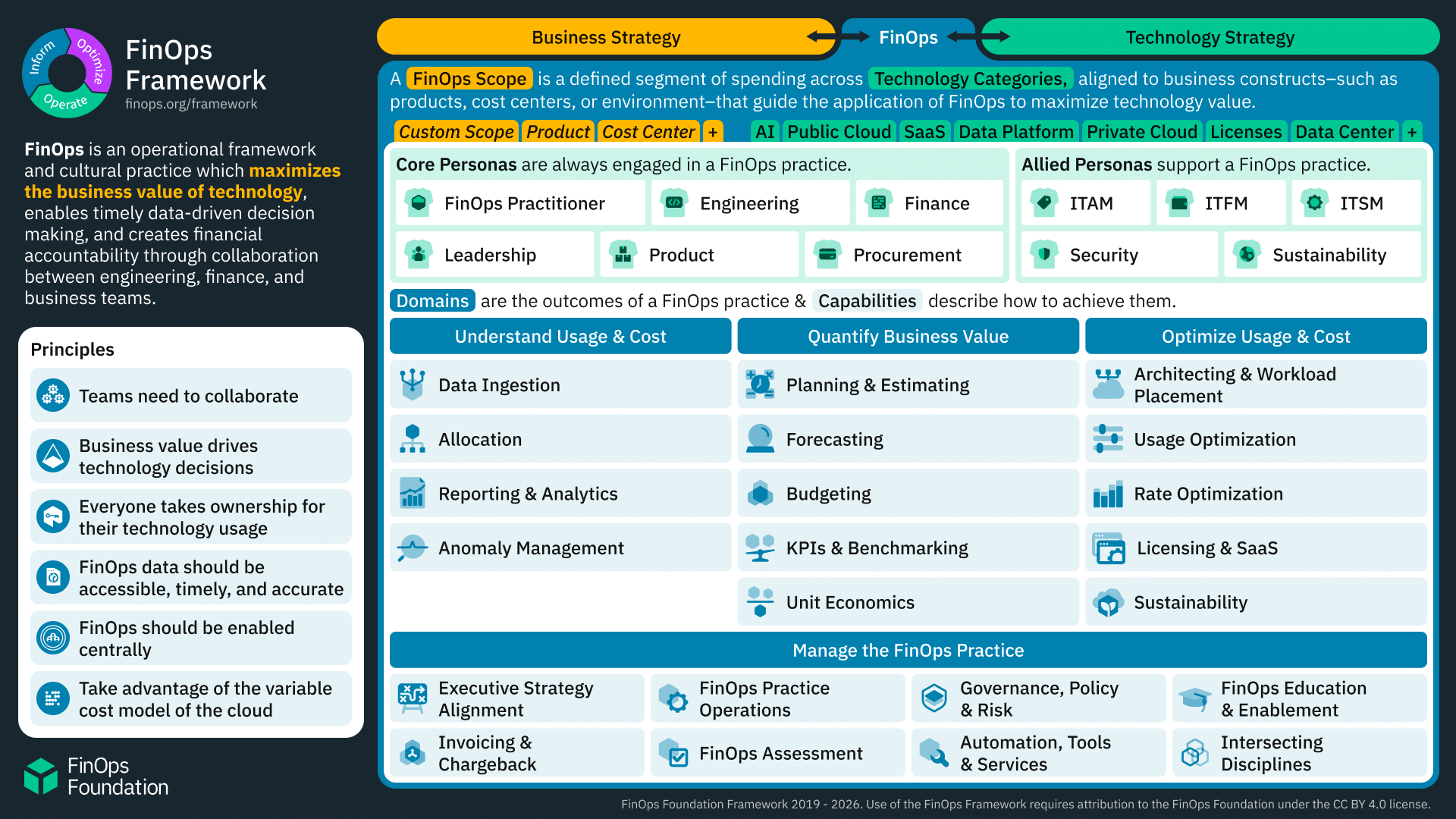
A FinOps Scope is a defined segment of spending across technology categories, aligned to business constructs–such as product, cost center, or environment–that guide the application of FinOps to maximize technology value.
FinOps Scopes establish the decision context and a shared reference to align stakeholders, activities, and outcomes within a FinOps practice. This context enables the development of practice profiles that determine which Personas are engaged, which Capabilities are applied, and which Domains define success.
A FinOps practice will typically define multiple FinOps Scopes as part of its overall profile. Considerations when defining a FinOps Scope may include: how frequently each Capability is performed, how strictly governance is applied, what KPI levels are expected, or how broadly optimization activities are performed. The choice to include or exclude any element of the Framework from a particular Scope should be intentional and can be visualized by navigating the Framework poster from the top down.
An organization’s business and technology strategies shape how a common set of FinOps Capabilities – such as Data Ingestion, Allocation, or Forecasting – are tailored and applied across different Scopes within a FinOps practice. While the goal of the Capability remains consistent, its inputs, KPIs, maturity, and measures of success may vary by Scope based on the decisions being supported.
For any area of IT investment, a FinOps practice may only need to focus on a specific segment of usage – like a hybrid Kubernetes deployment across public cloud and on-premises in an organization’s data center – resulting in the creation of a FinOps Scope with a distinct approach for just this segment of spending, combined with the shared operational and business considerations.
Scopes Are Driven by the Business & Technology Strategy
- Organizations define FinOps Scopes to align FinOps activities with specific business goals, constraints, and decision-making needs.
- A set of FinOps Capabilities is tailored and prioritized by Scope to support those needs.
- FinOps Personas are engaged or excluded based on the accountability and collaboration required within each Scope.
Scopes Reflect Decision Context, Not Infrastructure Boundaries
- A Scope may span multiple products, cost centers, or environments when decisions and outcomes cut across technologies.
- Multiple Scopes may exist within a single area of spend when distinct business objectives or constraints require different treatment.
- A common set of FinOps Capabilities is applied across Scopes, with KPIs and metric thresholds tailored to the outcomes each Scope supports.
Scopes Determine How Personas, Domains, and Capabilities are Engaged
- Elements of the FinOps Framework such as Personas, Domains, and Capabilities serve as foundational building blocks for FinOps Scopes.
- The inclusion or exclusion of these elements should reflect an organization’s FinOps maturity, business priorities, and situational context for desired innovation timelines and velocity.
- With Scopes, Practitioners structure FinOps activities, define ownership boundaries, and align teams around measurable outcomes.
- As the practice evolves, the profile of Framework elements engaged within each Scope may change.
- Scopes provide a construct for focusing improvement efforts across different areas of FinOps.
Only Create a New Scope When It Enables Better Decisions
- New Scopes should be introduced only when a distinct business outcome, constraint, or decision context requires them.
- Maintaining many Scopes introduces overhead, so Scopes should remain few, simple, and purposeful.
- A common set of FinOps Capabilities, Personas, and Domains can often be applied across Scopes with minimal variation.
How FinOps Scopes Evolve
Many FinOps practices initially operate with a default Scope aligned to cloud usage. While this is often described as “Cloud FinOps” the Scope is rarely about the technology itself. Instead, it reflects the business objectives driving cloud adoption, such as migrating services with the ambition of improving cost efficiency, modernizing infrastructure, or increasing delivery velocity.
As FinOps was first established, FinOps teams tailored their approach by selecting from the FinOps Framework building blocks—such as specific Capabilities, Personas, and metrics—in ways that align to the organization’s cloud adoption goals and constraints.
As cloud practices matured, organizations often introduced more targeted Scopes within their FinOps practices to home in on a subset of their cloud footprint. These Scopes are defined by distinct business contexts rather than by technology boundaries.
Examples of these more specific Scopes might include a Scope that manages the value of a key product portfolio, the spending around a key initiative supporting innovation activities, a new application designed to quickly expand into a new market, or spending related to achieving a specific business outcome such as achieving SOC2 or FedRAMP compliance. In each case, cloud spend is segmented not for classification, but to enable more precise application of FinOps Capabilities and influence decisions to achieve a defined outcome.
Over time, FinOps teams have been asked to support business objectives that require investment across multiple infrastructure categories, leading Scopes to span categories beyond public cloud. These Scopes reflect changes in business strategy and require FinOps teams to apply the same FinOps approach across different technologies, adapting to their differences without reinventing how FinOps works.
Today, emerging areas like AI-related activities further reinforce the importance of Scope being based on business context. AI investments span multiple technology categories, and organizations may have widely varying expectations, constraints, and risk tolerances. In these cases, the Scope is defined less by where the technology runs and more by what the business is investing in, how that investment supports differentiation or innovation, and how success is measured. FinOps Scopes provide the structure needed to align activities, reporting, and decision-making to those outcomes, regardless of the underlying technology mix.
How Business Questions Lead to FinOps Scopes
FinOps Scopes are not created because a topic is interesting or because a Practitioner wants to analyze a new area of spend. They are initiated in response to explicit business expectations, most often surfaced through questions from Leadership. These questions signal that the business is seeking to influence a decision, but the initial request alone is rarely sufficient to determine whether a new Scope is required.
A common trigger may be a question such as, “What are we spending on AI?” While this suggests that greater visibility is needed, the FinOps practitioner’s role is to understand why the information is being requested and what outcome the business is trying to achieve.
Techniques such as the Five whys can be used to draw out this context and avoid delivering an answer that is technically correct but strategically unhelpful.
For example, a conversation using the Five whys method might progress as follows:
Leadership: What are we spending on AI?
FinOps: Why?
Leadership: We want to understand how Team A and Team B are using AI.
FinOps: Why?
Leadership: We need to ensure we’re investing in the right types of AI infrastructure in the right places to support our key product teams.
FinOps: Why?
Leadership: We want these products to drive innovation using AI to differentiate us.
FinOps: Why?
Leadership: We want to stay ahead of competitors in AI adoption and grow market share.
By working through this dialogue, FinOps shifts from providing retrospective spend visibility to Practitioners acting as a strategic partner in shaping business decisions. The resulting context allows Practitioners to focus on the most relevant spending in the right technology segments, identify the decisions that need to be influenced, and determine whether existing Scopes are sufficient or a new Scope is required.
Only once this outcome and decision context is clear should a FinOps Scope be defined. The resulting Scope is shaped by the business objective – not by the technology itself – and informs how FinOps Capabilities, Personas, metrics, and reporting are applied to support that objective. This approach ensures that Scopes remain intentional, decision-focused, and aligned to delivering measurable business value.
The Lifecycle and Interaction of FinOps Scopes
FinOps Scopes are situational, they flex in duration and intensity to match the business objective being served. As Practitioners become more effective at identifying when a Scope is needed, they must also recognize when a Scope has served its purpose. Scopes exist to support specific outcomes, and when those outcomes are achieved, or are no longer relevant, FinOps practices should adapt accordingly.
Responding to these changes may involve small adjustments to how FinOps is applied to cater for a Scope, or letting the activities that support a Scope fade away once it no longer adds value. The goal is to keep FinOps aligned with business priorities, not to preserve Scopes for their own sake.
It is also important to recognize that FinOps Scopes are not always mutually exclusive. Technology usage may be included within multiple Scopes at the same time, particularly when different business outcomes or expectations apply. When this occurs, Practitioners must understand how applying FinOps in one Scope interacts with how FinOps is applied in another.
For example, an organization may have a Scope that covers overall cloud spending with expectations of highly accurate forecasting and minimal variance. At the same time, Agentic AI-related spend used to improve developer productivity may form a separate Scope that spans part of the cloud environment but carries different business expectations, such as increased tolerance for experimentation and variability. In this situation, the FinOps team must decide whether to adjust the cloud Scope to exclude AI usage, or to keep AI usage within the cloud Scope while explicitly accounting for its contribution to forecast variance.
Managing these interactions intentionally ensures that FinOps Scopes remain aligned to business outcomes, avoids conflicting expectations, and supports clear, decision-relevant insights across the practice.
Related Assets
Model Context Protocol (MCP): An AI for FinOps Use Case
Driving Cost Efficiency into AI Deep Learning Pipelines with FinOps

Introduction to FinOps for SaaS
Applying the FinOps Framework to SaaS at Scale
How FinOps Tools and Practices Can Help Control Licensing and Other Costs (Expedia Group)
Effect of Optimization on AI Forecasting

FinOps Considerations for a Data Center