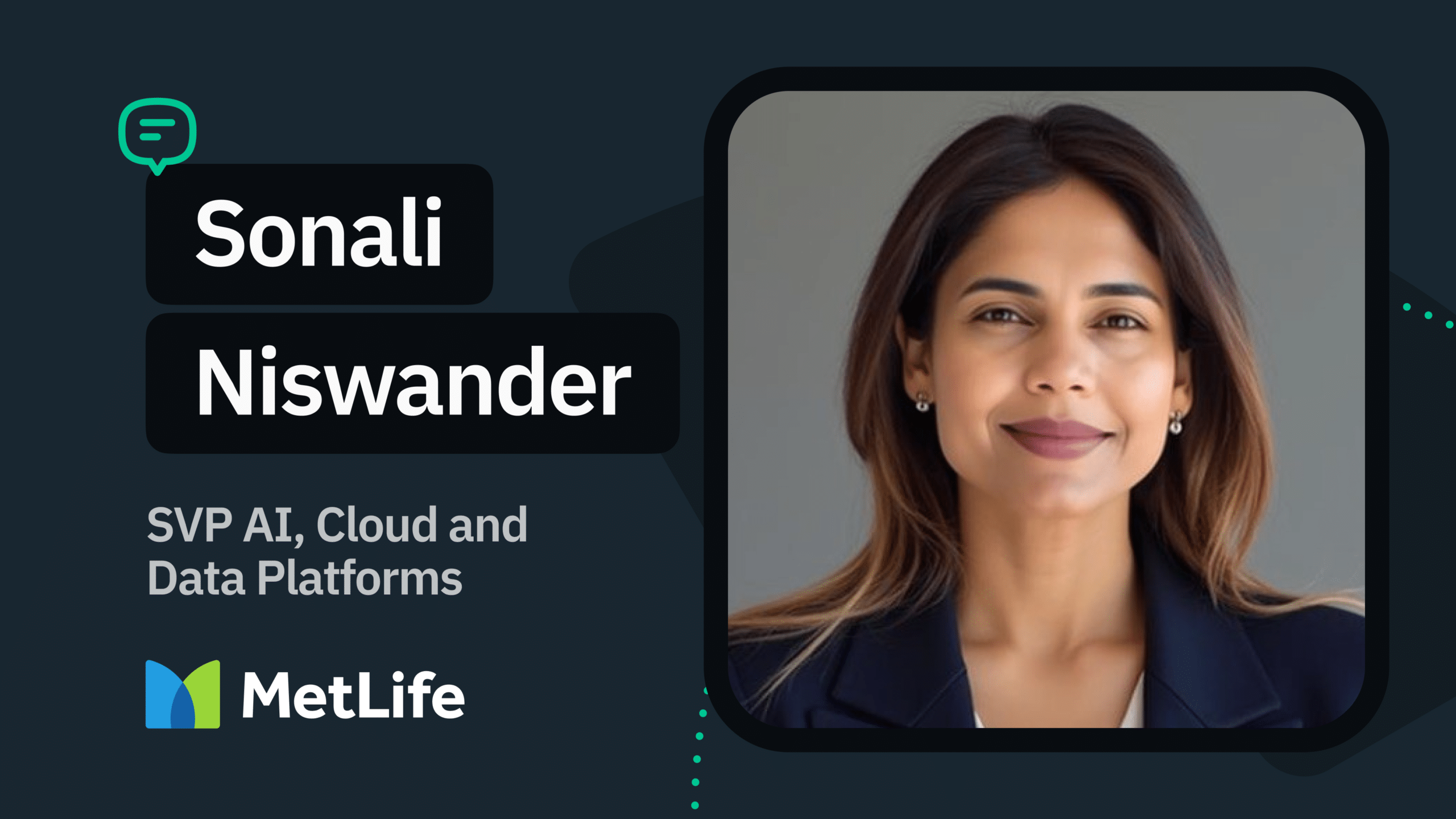
Sonali will be keynoting FinOps X in San Diego, June 8-11 2026. Attend to see her talk live.
Key Insight: Sonali Niswander, SVP AI, Cloud and Data Platforms of the Global Technology Office at MetLife, offers a window into how the FinOps mandate is shifting at the world’s largest regulated enterprises. Her story spans infrastructure roots in early e-commerce, through leadership at some of the country’s most recognizable companies, to overseeing cloud, AI, and business applications at a $71 billion global insurer. It is a case study in what it means to be a “biz tech” leader in an era when the rules about spending, forecasting, and even job titles are being rewritten in real time.
Sonali Niswander is SVP of the Global Technology Office at MetLife, where she oversees cloud, AI platforms, automation, and business application delivery across MetLife’s global regions. She joined the FinOps Foundation Executive Program in 2025, nominated by MetLife FinOps practitioner James Barney.
A Technologist Who Leads with Business
Sonali Niswander does not fit cleanly into the traditional technology executive archetype. Her career has moved across retail, healthcare, and financial services, through engineering and into the executive suite, and she holds both the technical credibility and the business fluency that the FinOps Foundation has identified as the signature combination of today’s most effective technology executives.
Ask her whether she considers herself an engineer or a businessperson, and she does not hesitate.
“I view technology as a means to an end,” she says. “It’s always the business angle that comes first, regardless of what role I’m in, whether I’m leading the cloud function or a business, facing tech function. It’s a biz tech role.”
That orientation shapes everything about how she runs her organization at MetLife. As SVP in the Global Technology Office, she reports directly to the company’s Global CIO and holds a portfolio that spans cloud, AI platforms, automation tooling, and the application teams that deliver sales and servicing solutions across MetLife’s global regions: EMEA, the Americas, Asia, and LATAM. The breadth of that remit, and the discipline with which she manages it, makes her a clear example of the emerging “Business-Technology Leader” archetype the Foundation has begun documenting across Fortune 100 regulated industries.
FinOps Is Broader Than Cloud
One of the first things Niswander wants practitioners to understand about her work is the scope of what FinOps means inside a global insurance enterprise. The conversation starts with cloud, she acknowledges, but it does not end there.
“FinOps typically—and I think this is how most people look at it—is only being seen as your cloud spend and how you optimize your cloud spend,” she says. “But it’s a lot broader than that. You’ve got your SaaS spend, all of software spend, including professional services and the labor component. FinOps applies. It’s a much more horizontal practice, the way I see it.”
At MetLife, the structure reflects this expanded view. A dedicated FinOps team manages cloud spend centrally. For SaaS and broader software spend, the practice is distributed across business units: a hybrid model that Niswander describes as a work in progress rather than a finished design. Her current thinking is to extend the mandate of that central team to take ownership of AI spend as well, bringing token costs, cloud-based inference, and third-party AI tooling under the same governance roof.
That kind of deliberate, staged expansion: cloud first, then SaaS, then AI, is a pattern the Foundation has observed at virtually every enterprise where FinOps has matured into a strategic function. Niswander is building that progression purposefully.
Balancing Speed and Discipline
At MetLife, Niswander runs both a governance portfolio and a delivery portfolio. The governance side includes the architecture function and a development center of excellence that establishes standards, patterns, and coding guidelines for the enterprise. The delivery side is the team actually building business-facing applications and internal developer tooling.
Holding both functions in one role creates a distinctive tension, and Niswander has a phrase for how she navigates it.
“I say this to my teams all the time: it’s about maintaining speed and discipline,” she explains. “And we’re unique in this, at least at MetLife. That balance goes into everything we do.”
In practice, the model has evolved. The earlier approac of “here are the rules, but here is some leeway, and we will give you time to remediate when you overstep” proved insufficient. The model MetLife is moving toward is more explicit: here are the guardrails, and you have full autonomy within them. Regional CIOs and their development teams operate inside those enterprise-level boundaries, but the boundaries themselves are regularly updated rather than treated as fixed.
“We draw the limits, and then there is complete autonomy that the teams have to play within those limits,” Niswander says. “It’s not a one and done. We keep updating those guardrails.”
This is the governance posture the Foundation has consistently found in the most effective regulated-industry technology organizations: not a fixed set of rules imposed from the center, but a living framework that enables speed without sacrificing accountability.
AI Is Cloud All Over Again—Only Faster
Few topics reveal the current state of enterprise FinOps more clearly than how organizations are handling AI spend, and Niswander is candid about where MetLife stands.
“I feel like we just got good at estimating our cloud spend and sticking to it,” she says. “But now AI is completely changing the game.”
The parallel to early cloud is not lost on her. The FinOps Foundation has often noted that organizations that went through the discipline of cloud cost management (i.e.,learning to forecast consumption-based spend, building accountability into engineering teams, tying spend to business outcomes) are better positioned for the AI challenge than those that did not. Niswander has lived that journey.
What makes AI different, in her view, is not just the technical complexity but the mismatch with enterprise financial cycles. MetLife sets its budget eighteen months in advance. For a SaaS contract or a steady-state cloud workload, that cadence is workable. For generative AI, where new models, new vendors, and new use cases emerge weekly, it creates real friction.
“We can’t go away from forecasting,” she is clear about that. “We still need some level of estimation and planning. But we’re giving ourselves enough room for any changes that happen, especially with regards to AI spend. Estimating AI spend is still an evolving art.”
The response MetLife has developed is a two-track approach. A central budget has been allocated specifically for AI experimentation—dollars explicitly designated to let teams try new tools and models without forcing them to compete against production workloads for funding. Beyond that, the broader principle is one of active trade-off management: as AI spend grows, something else must offset it.
In developer productivity, at least, those offsets are beginning to materialize. As AI-assisted development tools have matured, Niswander says MetLife is seeing real productivity gains, and she is careful to frame those gains not as headcount reduction but as increased capacity.
“We’re not just looking at reducing labor, but having the same labor spend do more,” she says.
Measuring What Actually Matters to the Business
How do you know if developer productivity is actually improving? It is a question the entire industry is wrestling with, and Niswander’s answer reflects the pragmatic, business-first perspective she brings to every part of her role.
At the developer level, her teams track granular metrics: story points, deployment frequency, release cadence. But she is clear that those are input metrics. The measure that matters most is the one the business cares about.
“What we’re honing in on is: how quickly are we delivering the products and feature sets?” she says. “That’s the business-facing metric.”
She is honest that standardizing this measurement across MetLife’s distributed regions is still a work in progress. Some business units are more advanced than others. But the direction is clear: consolidate around outcomes, not activity.
This kind of outcome orientation: shifting from “how much did we spend” to “what did that spend actually deliver” is one of the clearest signals that a FinOps practice has moved beyond cost optimization and into genuine business partnership. Niswander is building the infrastructure for that conversation.
The Emerging Role: “COO for the CIO”
Niswander’s role aligns closely with what the Foundation commonly observes as the “COO for the CIO” archetype: the cross-functional technology operations executive in a regulated industry who provides unified governance across business units, manages the expanding scope of technology spend, and translates all of it into strategic business terms for a global CIO and board.
The COO analogy captures the operational governance mandate: standards, guardrails, financial discipline, and cross-organizational alignment. The technical depth captures the credibility that makes all of it work; the ability to engage with architects and engineers as a peer, not just as an administrator.
Looking ahead, Niswander sees her own path extending in both directions. She is also watching the emergence of a Chief Product Officer profile, someone who can hold both the business product vision and the technology delivery capability in a single role, rather than requiring a handoff between two different people.
“With AI, there is no reason why a business product owner could not use AI to shape and build products,” she observes. “Those roles are coming together.”
What MetLife’s Story Tells Us about the State of FinOps
What Niswander is navigating at MetLife is not unique to MetLife. They show up in the data. The State of FinOps 2026 survey (drawn from 1,192 respondents representing more than $83 billion in annual cloud spend) documents the same pressures playing out across the industry. Ninety-eight percent of organizations are now managing some form of AI spend, up from just 31% two years ago. AI cost management has become the top skillset FinOps teams are trying to add.
The data also validates her instinct about where FinOps influence matters most. Practitioners with VP, SVP, or C-suite engagement show two to four times more influence over technology selection decisions than those engaging only at the director level. Cloud service selection, cloud provider choice, cloud versus data center placement, all of these decisions become meaningfully more within reach for FinOps when the practice has executive alignment. Niswander’s role, sitting directly under the Global CIO with ownership across cloud, AI, and application delivery, is precisely the organizational positioning that the data says unlocks that influence.
“I’m sure others are tackling the same challenges,” she says. “It’ll be good learning through networking.”
That orientation toward shared problems rather than proprietary answers is what makes practitioners like Niswander valuable to the broader community. The AI forecasting model is still evolving. Developer productivity measurement is still a work in progress. The expansion of FinOps governance to cover AI spend is still being designed. But the questions Niswander is asking, and the framework she is building to answer them, sit squarely at the frontier of where the entire field is headed.
Sonali will be keynoting FinOps X in San Diego, June 8-11 2026. Attend to see her talk live.
Join the FinOps Newsletter
Keep up to date with the latest news from the FinOps Foundation, our partners and practitioners.