FinOps & ITAM Practical Scenarios: Deliver & Govern
Summary: To maintain operational control and financial accuracy, FinOps and ITAM must collaborate during the Deliver and Govern phase of the technology lifecycle. This partnership ensures that services are deployed with strong compliance and cost visibility across hybrid, cloud, and SaaS environments.
As FinOps and ITAM approaches converge, the opportunities for joint impact grow, but so do the challenges. The State of FinOps 2026 Report confirms that collaboration between these teams continues to increase year over year (20% increase since 2025), making practical guidance on how to work together effectively more relevant than ever.
These practical technology delivery and governance scenarios illustrate where FinOps and ITAM teams commonly deliver greater value when they work together across the technology asset lifecycle. These examples span both enterprise level decisions, such as informing multi year planning and strategic investment choices, and asset level activities, where joint visibility and continuous management and governance improve efficiency, optimize value and reduce risk.
Practitioners contributed these scenarios to help readers recognize the situations where collaboration between FinOps and ITAM becomes more effective than either discipline acting alone, and to provide guidance on how to work through the associated challenges.
Every organization will differ in structure, scope, and maturity, so not every scenario will apply directly, but the patterns reflect real world experience and are intended to inform, inspire, and support practical action. The scenarios are not an exhaustive list, just high impact ones identified.
Review additional FinOps & ITAM key scenarios where the collaboration of these two teams can deliver increased technology value.
Unified FinOps and ITAM Practical Scenarios Overview
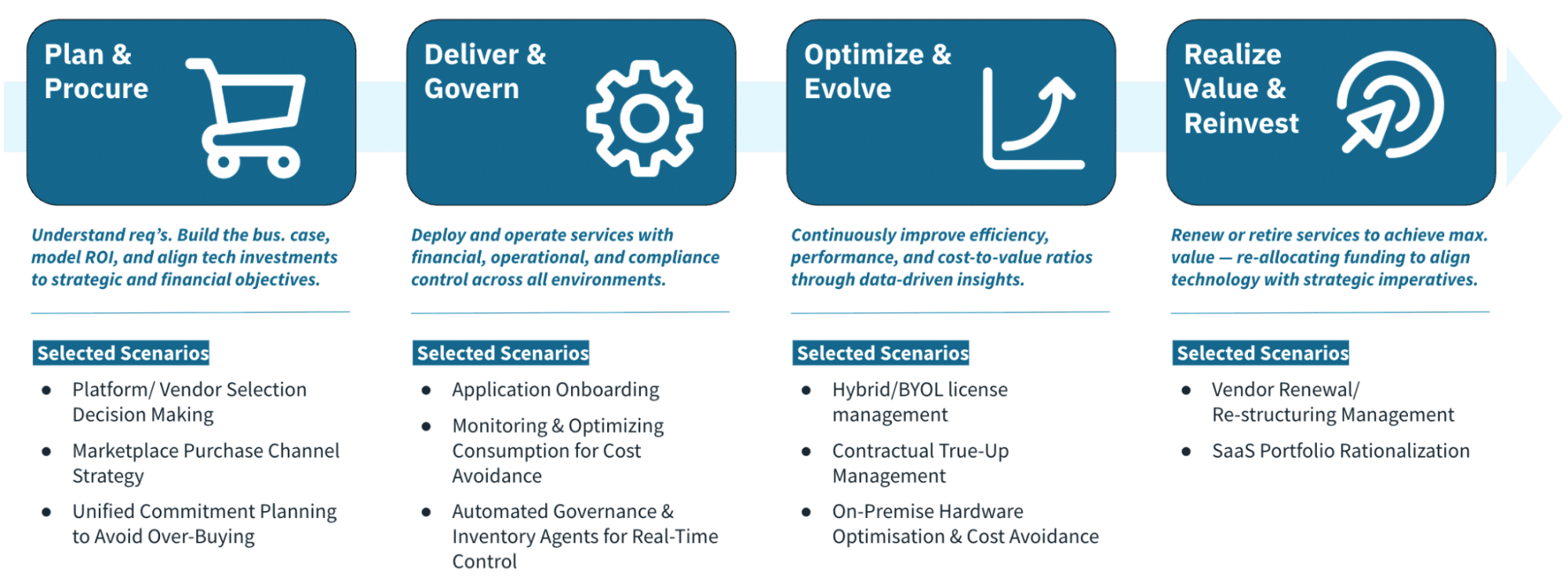
Note: Scenarios can be considered independently of each other. There may be some overlap in guidance and practical steps between examples, where they have overlapping core components.
What are key Deliver and Govern scenarios that FinOps & ITAM encounter?
Deliver and Govern focuses on deploying and operating services with strong financial, operational, and compliance control across all environments. In this phase, FinOps and ITAM practitioners commonly collaborate on scenarios such as onboarding applications to establish end to end cost visibility, monitoring and optimizing consumption through anomaly detection and forecasting to sustain cost avoidance, and managing contractual true ups to maintain financial accuracy and compliance.
Application Onboarding
- Impact: 4 out of 5
- Complexity: 3 out of 5
When new applications are introduced, organizations often struggle with fragmented onboarding processes, unclear ownership, and incomplete financial or entitlement visibility. Also consider possible duplication of applications’ capability across the organization. To limit SaaS sprawl, teams should investigate existing software prevalent in the organization as part of the onboarding process.
These gaps create early cost exposure, compliance risks, and unexpected variance once the service goes live. The following scenario illustrates how FinOps and ITAM collaboration during application onboarding helps balance cost efficiency with risk management, especially when subscription models and workload migrations converge.
An enterprise is onboarding a new SaaS application that offers subscription services with tiered pricing. This project also involves migrating workloads that were running on premises into this new SaaS application. Primary focus is cost and risk. Balancing cost efficiency with risk management.
Objectives & Success Criteria
- Achieve cost optimization from leveraging negotiated discounts and pricing tiers.
- Maintain license compliance with the vendor’s licensing terms
- Improve forecasting of future usage and tier alignment
- Establish an accurate and complete record and governance framework for this vendor/application
FinOps Framework Capabilities
The following domains and capabilities should be considered in relation to this scenario.
- Understand Usage and Cost Domain: Data Ingestion, Allocation, Reporting & Analytics, Anomaly Management
- Quantify Business Value: Forecasting, Budgeting, Anomaly Management
- Optimize Usage and Cost: Architecting for Cloud, Rate Optimization, Workload optimization, Licensing & SaaS
- Manage the FinOps Practice: FinOps Tools and Services, Policy and Governance, Intersecting Disciplines
Skills Required
- Financial Modeling and Forecasting: Understanding expected consumption, subscription tiers and long term spend profiles so FinOps and ITAM can jointly evaluate costs, plan commitments and prevent over provisioning during onboarding.
- Licensing and Contract Analysis: Reviewing subscription tiers, entitlements and migration related use rights to ensure the chosen model is compliant, cost efficient and avoids duplicated licensing if moving on-premises workloads to SaaS platform.
- Cloud Architecture Awareness: Interpreting how migrated workloads will operate within the application architecture, including how metering, performance tiers and integration patterns influence cost and entitlement requirements.
- Data Analytics and Normalization: Bringing together usage, billing and entitlement data to produce a consistent early financial view, supporting accurate cost allocation and reducing variance as the application goes live.
- Governance and Policy Development: Defining approval paths, provisioning rules and lifecycle controls to manage spend exposure and compliance risk throughout the onboarding process and into steady state.
Practical Steps
- Pre-Onboarding Assessment
- Validate application licensing models and SaaS subscription tiers
- Validate any duplicate SaaS to avoid SaaS sprawl (ideally this has been resolved pre-purchase and onboarding)
- Validate any burstable or additional consumption that may occur within your hyperscaler accounts/projects/subscriptions.
- Align enterprise tagging standards for cost allocation at the right granularity
- Contract & Commitment Alignment
- Review enterprise cloud commitments against vendor licensing models.
- Add Notifications and approval gates against budgets for consumption spending
- Integration & Tooling Setup
- Connect ITAM/SAM tooling if available
- Connect FinOps tooling if available
- Add a complete record of the application to your software asset inventory
- Operational Governance
- Define a cadence for usage reviews and renewal checkpoints
- Implement automated alerting for non-compliance and cost anomalies
- Reoccurring Optimization
- Benchmark application performance and cost trends
- Define a cadence to review license reclamation and rightsizing
Key Personas & Operating Cadence
- FinOps and ITAM/SAM Practitioner:
- Weekly or monthly cost and optimization reviews.
- Monthly license compliance checks and cost optimization reviews
- Procurement: Contract negotiation and renewal cycle alignment
- Engineering: Tagging and workload placement adherence and monthly review of resource optimizations identified.
- Finance: Budget validation and variance analysis
Data, Tooling, Dashboards & Metrics
- Key Datapoints:
- License entitlements
- SaaS & Cloud Usage
- Cloud commitments
- Vendor and cloud optimization recommendations
- Tooling: For off the shelf solutions you can view the FinOps Landscape for solutions that support SaaS, FinOps or both.
- Metrics: Compliance Posture, license utilization, commitment coverage & cost variance to forecast and budget.
Continuous Improvement & Anti-patterns
- Quick Wins: Early tagging enforcement & license reclamation
- Long-term: Automated compliance checks, tailored automated optimization checks, predictive cost modeling and forecasting.
- Anti-Patterns: Tools only fixes without process alignment & manual reporting
Monitoring and Optimizing Consumption for Cost Avoidance
- Impact: 4 out of 5
- Complexity: 4 out of 5
Monitoring and optimizing consumption is a critical joint activity for FinOps and ITAM when dealing with consumption based SaaS models. Without coordinated visibility, organizations often commit to higher consumption levels driven not by real growth but by avoidable overages, misconfigurations or inefficient usage patterns. This scenario illustrates how proactive monitoring, anomaly detection and joint optimization can prevent unnecessary spend before it locks in at renewal. This scenario covers Efficiency and Cost.
A company purchases a consumption based SaaS application with an agreed upon amount of consumption units per SKU. If consumption exceeds the SKU limit during a given month, the company will be charged for overages at a different specified rate. At the end of the contract term or true up window, the company is forced to increase the level of consumption for the SKUs they have consistently exceeded. The increased consumption is not all growth, but may include unintended consumption due to misconfiguration or consumption that could be optimized or even omitted if reviewed.
Objectives & Success Criteria, KPIs
- SKU-level consumption visibility is available
- SKU-level forecast and progress towards consumption limits are available
- Anomaly detection or threshold-based monitoring & alerting is implemented
- No overages are incurred
- Add-ons at the contract rate are added for true, sustained growth
FinOps Framework Capabilities
The following domains and capabilities should be considered in relation to this scenario.
- Understand Usage & Cost Domain: Anomaly Management, Reporting & Analytics
- Quantify Business Value Domain: Forecasting
- Optimize Usage & Cost Domain: Workload Optimization
- Manage the FinOps Practice: FinOps Tools & Services
Skills Required
- Application Specific Knowledge: Understanding how the SaaS application measures and consumes units per SKU, allowing teams to distinguish true growth from misconfiguration or avoidable activity that drives overages.
- Licensing Knowledge: Interpreting SKU limits, overage rates and true up rules so FinOps and ITAM can identify when excess consumption reflects inefficient usage rather than a genuine need to increase contracted levels.
- Monitoring and Observability Configuration: Using in-application tools, observability platforms or custom monitoring solutions to configure alerts and consumption tracking, enabling early detection of unintended usage before it results in recurring overages.
Practical Steps
- At contract start, identify all SKUs, their consumption “limits”, whether you are charged for overages and how frequent, at what rate overages are charged and whether there are true-up periods throughout the contract term.
- Ingest consumption data, at the SKU level, into another tool or platform (if you are leveraging one).
- Monitor consumption for each SKU and configure alerts when anomalies are triggered or certain thresholds are met (this may be available within the SaaS platform itself, or in the tool/platform you’ve ingested your SKU-level consumption data into).
- FinOps, ITAM and Engineering should collaborate on investigating anomalies to determine if they were one-time events or the start of new growth and also implement optimizations that are found as part of the process.
- Establish a clear baseline forecast, and use forward-looking forecasting models to understand projected end-of-term consumption. Monitor the percentage of contracted capacity consumed for each SKU over time so corrective actions can be taken early if limits are likely to be reached.
Key Personas & Operating Cadence
- FinOps & ITAM: Handle the steps to set up and manage the process of reacting to anomalies and notifying impacted personas.
- Engineering: Engaged for ad-hoc root cause analysis to validate if the anomaly was temporary or will sustain.
- Procurement: Involved ad-hoc in the event there are add-ons during the contract term.
- Finance: Informed if ad-hoc overages and/or growth impact the budget and forecast.
Risks, Trade-offs & Dependencies
- If no monitoring and investigation take place and overages are paid blindly, you will likely be paying a higher price than necessary; if you have true growth, for example, the contract may have the option for you to add-on at a lower price versus pay a higher rate for overages monthly; knowing the details of the contract terms could save you money
- Anomalies may be real growth, but when they aren’t, root cause needs to be determined; not addressing the root cause in the moment will only make it harder down the road; engaging immediately with engineers may uncover misconfigurations or real code problems that are likely the result of a recent action or deployment; there is a higher likelihood of resolving the issue or making even more optimizations if the anomalies are addressed in a timely manner
- If you are not tracking your SKU-level consumption against your monthly or annual contract commitments/limits, you will end up burning through your consumption early and either pay overages or may even be forced into an early renewal; tracking progress throughout the contract term – not just at renewal time – gives you the ability to course-correct and avoid cost penalties
Business Value of Outcome
- Avoiding unnecessary overages
- Avoiding buying more consumption when there is opportunity for optimization
- Detecting real configuration or code issues that impact the consumption and have other downstream effects (i.e. performance issues, other bugs)
- Able to go into the renewal with a solid understanding of consumption and be able to confidently negotiate based on real, optimized numbers instead of guessing or just adding a % increase
Data, Tooling, Dashboards & Metrics
- Data: all data related to the contract
- Tooling/Dashboards: SaaS built-in features, observability tooling that allows monitoring of ingested usage, third-party FinOps or ITAM tool or a DIY ETL + monitoring/alerting solution
- Metrics: % used / total units (per SKU); total $ of overages
Example SaaS Reporting – Contract & Limit Progress

Source: FinOps X Europe 2024 – Applying the FinOps Framework to SaaS at Scale – Amy Ashby & Lindbergh Matillano
Example SaaS Reporting: Usage Trend & Drawdown Progress

Source: FinOps X Europe 2024 – Applying the FinOps Framework to SaaS at Scale – Amy Ashby & Lindbergh Matillano
Continuous Improvement & Anti-Patterns
- Doing nothing will cost you more in the long run; don’t be the person who plans to renew every year at a set % increase
- Visibility is key – even if the first few iterations are manual; get the data, do the analysis and get it in front of engineers and leaders for feedback as soon as possible
- Automation is the key to operational success; once you are monitoring multiple SaaS applications, you won’t have time to review them; set up automation and repeat the process; then focus on anomalies
- Don’t go into a renewal without fully understanding your usage; you are leaving money on the table and may put yourself in a situation where a vendor won’t let you decrease the spend or will be penalized if you do; take the time and it will pay for itself!
Automated Governance and Inventory Agent for Real-Time Control
- Impact: 5 out of 5
- Complexity: 5 out of 5
Automated governance and real-time inventory control is an increasingly important scenario as organizations manage large hybrid estates spanning cloud VMs, on-premises servers and containerized workloads. Ensuring accurate, current visibility of configuration, usage, licensing and entitlement data is a persistent challenge when traditional inventory processes operate on delayed or incomplete information.
In this scenario, lightweight discovery and compliance agents, or agentless connectors, are deployed across cloud and hybrid environments to capture real time operational, licensing and configuration signals. These data points are integrated with cost and consumption information to create a unified and trusted inventory source. By linking entitlement, usage and financial telemetry in near real time, practitioners enable automated financial governance and continuous inventory management, improving accuracy, reducing manual effort and strengthening compliance across the estate.
Objectives & Success Criteria, KPIs
Objectives
- Maintain accurate inventory and financial governance across hybrid and cloud environments.
- Mitigate risk by preventing deployment of unauthorized/unsupported applications.
- Drive automated optimization actions based on consistent data.
Success Criteria
- Unified inventory data is consistent and trusted by all disciplines (FinOps, ITAM, Security, Procurement, Legal, IT Finance).
- Manual audit effort is significantly reduced.
- Waste is cut from unmanaged or orphaned resources/licenses.
- Automated workflows successfully trigger actions (e.g., tag fixes, shutdowns).
KPIs
- Compliance status of deployed resources.
- Percentage of resources with accurate allocation metadata.
- Reduction in cost due to automated license re-harvesting or resource shutdowns.
FinOps Framework Capabilities
- Understand Usage & Cost: Data Ingestion, Allocation, Anomaly Management
- Optimize Usage & Cost: Workload Optimization
- Manage the FinOps Practice: Policy & Governance
Skills Required
- License Entitlement Verification: Ability to validate license eligibility in real time as new cloud VMs, containers or servers are discovered, ensuring automated governance rules accurately prevent non-compliant or duplicate deployments.
- Contractual Compliance Interpretation: Skill in applying vendor specific contractual and compliance requirements to automated checks, enabling the inventory agent to enforce correct usage conditions without manual review.
- Software Asset Lifecycle Management: Capability to maintain accurate lifecycle status for hybrid assets so the automation system can distinguish active, dormant and retired resources when applying cost and compliance policies.
- Authoritative Inventory Stewardship: Responsibility for maintaining a single, trusted inventory of configuration, licensing and usage data that automated cost and governance workflows rely on for correct decision making.
- Automated Governance Configuration: Experience in designing and tuning rule based automation that continuously validates configuration, usage and entitlement signals to prevent cost leakage and compliance drift.
- Continuous Monitoring and Anomaly Detection: Proficiency in configuring and interpreting real time alerts that flag unexpected changes in deployment patterns, enabling rapid response to emerging cost or compliance risks.
- Data Pipeline and Ingestion Management: Skill in integrating agent or connector outputs into a centralized data store, ensuring high quality, standardized telemetry that supports automated governance and financial controls.
- Technical Tagging and Metadata Standards: Ability to define and enforce consistent tagging and metadata structures across hybrid environments so automated policies can reliably identify ownership, environment and entitlement context.
- Alert and Event Interpretation: Capability to triage automated signals, assess business impact and coordinate remediation efforts when governance violations, cost anomalies or compliance issues are detected.
Practical Steps
- Deploy lightweight discovery and compliance agents (or agentless connectors) across all target endpoints.
- Integrate the collected configuration and usage data with financial cost and consumption signals.
- Define automated policies (guardrails) for resource usage, such as shutdown schedules or license re-harvesting conditions.
- Implement automated workflows to execute actions like tag corrections, resource disposal, or license reclamation upon detection of non-compliance/waste.
Key Personas & Operating Cadence
Key Personas
- FinOps: defining automated controls/cost accountability),
- ITAM/SAM: providing entitlement data and validating compliance requirements),
- Security: relying on consistent inventory data for risk management
- Engineering: responsible for deploying agents and acting on optimization recommendations.
Operating Cadence
Real-time data integration and continuous monitoring are essential. Regular collaboration is needed to refine policies and review anomalies.
Risks, Trade-offs & Dependencies
Risks
- Significant financial penalties due to undetected compliance issues or license overruns.
- Continued waste resulting from reliance on siloed data sources. Security risks associated with unmanaged/outdated assets.
Dependencies
- Requires a consistent and established tagging strategy for effective allocation.
- Success is highly dependent on achieving strong data quality and attribution across all reporting systems.
Business Value of Outcome
- Provides unified governance automation ensuring all IT assets conform to policy.
- Cuts costs by reducing waste from orphaned resources or unnecessary software licenses.
- Mitigates compliance risks by ensuring license entitlements are respected in real-time.
- Reduces friction and speeds up decision-making by enabling FinOps, ITAM, and Security to operate from consistent, trusted, real-time asset data.
Data, Tooling, Dashboards & Metrics
Data
- Inventory metadata (ownership, configuration) collected by agents, licensing, and entitlement data
- Cloud cost and usage telemetry (consumption signals)
Tooling
- Lightweight agents/connectors
- ITAM/SAM platforms
- Cloud Cost Management tools
Dashboards/Metrics
- Unified asset inventory dashboards
- Compliance status dashboards
- Automated anomaly and alert reports surfacing non-compliant spending
Continuous Improvement & Anti-Patterns
Continuous Improvement
- Regularly evaluate the effectiveness of automated governance policies and refine rules based on usage patterns and cost impacts.
- Implement bidirectional education to ensure both teams understand the compliance rules and technical usage data.
Anti-patterns
- Attempting inventory/compliance tracking without a unified data source, relying instead on segregated ITAM and FinOps tools/data.
- Failing to implement monitoring and tracking tools quickly after BYOL deployment (recommended within 90 days).
Other FinOps & ITAM Scenarios
Learn more about the intersection of FinOps and ITAM in the context of additional, distinct scenarios where the collaboration of these two teams can deliver increased technology value.
Acknowledgments
We’d like to thank the following people for their work on this Paper:

Ron Brill
Anglepoint
Rich Gibbons
Synyega
George Arezina
TAKEDA
Victoria Levy
Sailpoint
Lorant Kiss
Delivery Hero
Keith Hiszem
Cardinal Health
Amy Ashby
Under Armour
Colin Jack
Flexera
Robert Nieuwenhuizen
McKinsey
Salomé Keet
FNB South Africa
Savina Stoykova
TP ICAP
Kevin Wade
SHI International Corp.
Parker Nancollas
SoftwareOne
David Gibbons
HSBC
Ben Pippenger
Zylo
Martin Thompson
ITAM Forum
John Cafferty
Lloyds Banking GroupLast updated: April 7, 2026
