
Intersecting Disciplines
Coordinating FinOps activities with other interconnected disciplines or Allied Personas (such as, ITAM, ITFM, Sustainability, Security) that exist in the organization, and which manage related technology responsibilities that also contribute to organizational strategy and value.
Collaborate with appropriate Allied Personas
- Create a common understanding of organizational goals
- Align goals and objectives across intersecting disciplines
- Define team responsibilities, enablement, and interaction, including shared objectives across teams
- Coordinate and confirm organizational responsibilities and expected outcomes with leadership
Information and Data Coordination
- Define intersecting and shared data, resources, and terminology to be used in coordination (e.g. FOCUS)
- Establish key metadata, data access, data resolution, exchange format, and data refresh cadence for information sharing or access
- Define common decision making workflows, communication channels and cross-team notifications
Definition
The Intersecting Disciplines Capability supports interactions between FinOps and other IT disciplines, frameworks, or teams that may exist in an organization. The intention of this capability is not to define how FinOps teams should perform these other disciplines, but to provide a common set of activities to allow FinOps to coordinate, cooperate, and collaborate with other technology and IT Management disciplines when they are in place.
Not every organization will have all, or any, of these other disciplines. For example, in some organizations, the FinOps team may perform Software Asset Management (SAM) functions, or there may not be an IT Financial Management (ITFM) team outside of Finance. The point of this Capability is not to encourage organizations to adopt these other disciplines, but rather to prepare FinOps teams to work with those already in place.
Intersecting Disciplines a FinOps team works with might include:
- IT Financial Management (ITFM) teams doing reflective IT cost categorization
- IT Asset Management (ITAM) or Software Asset Management (SAM) teams managing contractual value and risk over the lifecycle of software and hardware assets
- IT Service Management (ITSM) teams managing the delivery of IT services to the organization, and who have operational responsibility for some systems
- IT Security teams who manage the IT security posture of the organization internally and externally
- Enterprise Architecture teams who manage overall standards and technology strategy for the organization
- Platform Engineering teams who are responsible for managing key portions of the IT infrastructure being used to deliver value consistently
- DevOps or SRE organizations that operate across application teams and have responsibility for implementation, delivery, or operations of IT services
- Portfolio Management teams that manage the logical groupings of applications in business portfolios to achieve certain organizational objectives
To support real-time decision making across the technology estate, FinOps teams will need to understand the goals, actions, and granular data used by any intersecting discipline. Embrace the FinOps Principle of “Teams need to collaborate” to make the interaction with Allied Personas and intersecting disciplines really contribute to organizational success.
Maturity Assessment
To be most effective at achieving strategic value, organizations should require integration of FinOps with all other intersecting disciplines that exist. This integration may be through team consolidation, common leadership, or through formal or informal coordination of data, processes and standards between separate teams.
Organizational change is complex, particularly in large organizations. The importance of close interaction between disciplines will also change over time, or be more important for some FinOps Scopes than others. Regularly revisit (and adjust) how FinOps works with other disciplines, treating it as a core part of your maturity evolution.
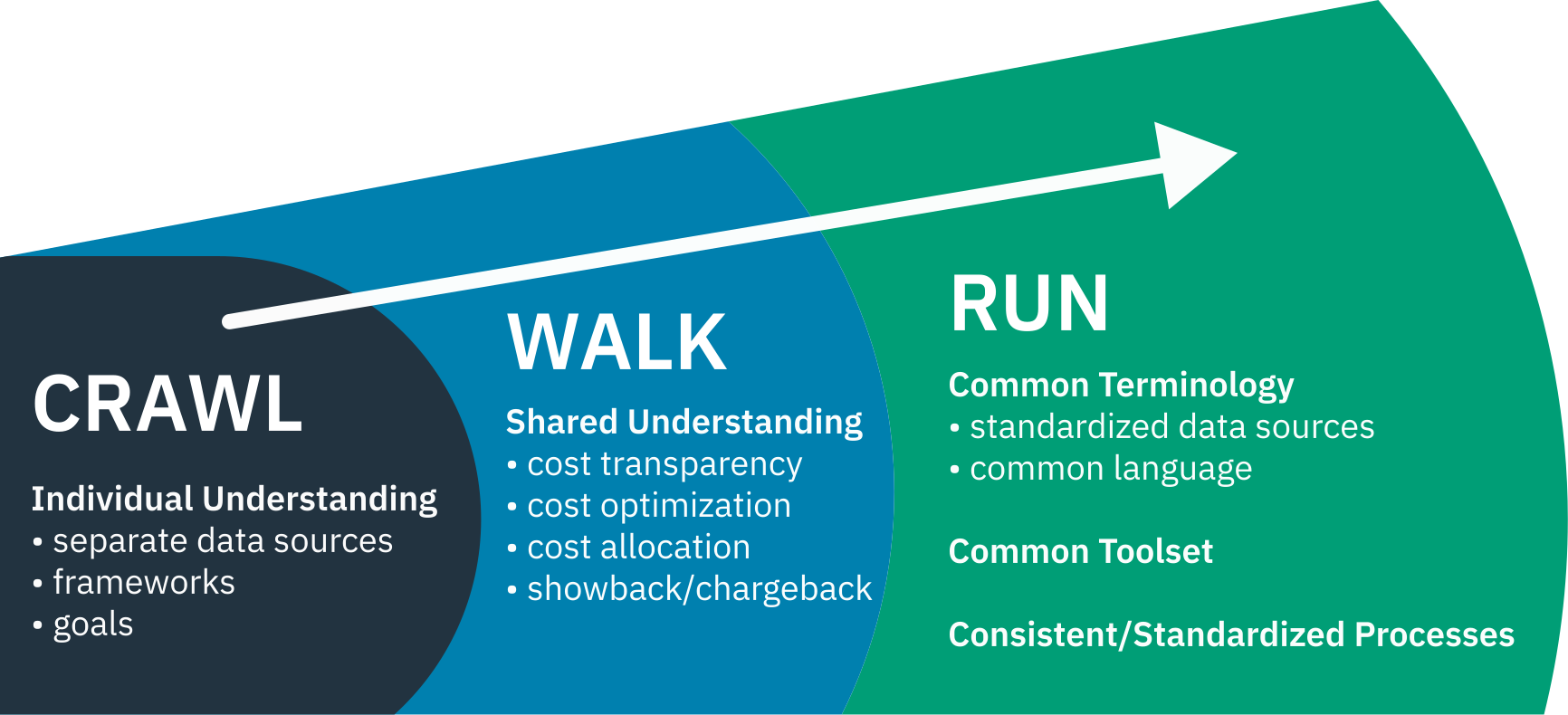
The maturity of the relationship between FinOps and any other discipline can be broadly described in the graphic below. Further details are also provided.
Maturity Assessment
Crawl
- FinOps and other teams may have separate reporting structures within the organization.
- FinOps Practitioners and other disciplines are aware of one another, but both own individual understanding of and responsibility for their areas of focus.
- Education and Enablement or other coordination between disciplines takes place only when required.
- Intersecting disciplines have individual understanding of how resources are being paid for and consumed. They possess in-depth knowledge of their respective frameworks, information sources, goals, and experiences. They can analyze and assess relevant information to determine outcomes specific to their disciplines.
Walk
- FinOps and the Intersecting Discipline share the same reporting structure.
- Teams have a shared understanding / view of resource usage and cost and how these costs are forecasted, budgeted, reported upon, and charged back.
- Allied Personas are consulted regularly for decision making. For example, FinOps team includes the Software Asset Management (SAM) teams when suggesting Bring Your Own License (BYOL) models because of the well-understood impact to existing contractual commitments with the software publishers.
- There is a shared understanding of organizational data related to cost, usage, and business context.
- FinOps teams have partnered with Allied Persona teams to achieve a shared understanding of usage and cost. They regularly coordinate to provide a comprehensive view of the organization.
- There is also a shared understanding of each other’s respective frameworks and processes, allowing for effective communication and analysis.
Run
- FinOps and other discipline teams are integrated or operate within a single team or organization.
- There is a common data repository / source for the management of cost, usage, and context used across disciplines to enable the organization to build an understanding of the total cost of ownership (TCO) and return on investment (ROI) of technology investments.
- FinOps and other disciplines are closely aligned and work together to ensure an optimized IT investment landscape.
- Considerations of cost, usage, performance, architecture, security, operations, reliability, and other factors are regularly considered by engineering teams with all inputs to decision making well understood.
- Operational tools and processes are scaled to support agility and cooperation between functions.
- A common toolset including software applications and methodologies is used to enable either some or all FinOps & Allied Persona team processes.
- Recurring actions are performed consistently in a standardized manner by all involved.
Functional Activities
 FinOps Practitioner
As someone in the FinOps team role, I will…
- Establish and maintain clear lines of communication and coordination with other functions within the organization
- Understand how organizational spending aligns with other taxonomies and overall technology Total Cost of Ownership.
- Ensure allied teams have access to the data, embracing the FinOps Principle “FinOps data should be accessible, timely, and accurate”
- Align tools, reports, and data sources between FinOps and other frameworks for reliability and user-friendliness so stakeholders get harmonious and dependable information from both functions
- Determine and highlight usage impacting other disciplines (e.g. software license use, platform operational data)
 Product
As someone in a Product role, I will…
- Use the information from the FinOps teams and other disciplines together to determine the optimal design and architecture to build business solutions
- Use information from the FinOps teams and Allied Personas to understand the total cost of ownership (TCO) of investment decisions
- Enable IT financial governance and policy on consumption within my business unit
- Review and validate FinOps and intersecting discipline cost reports
 Finance
As someone in a Finance role, I will…
- Leverage information from both FinOps teams and intersecting disciplines for budget planning and forecasting
- Understand how FinOps intersectionality with other disciplines can enhance IT spend transparency and utilize their insights across the organization
- Determine how to identify costs within the accounting system of record and systematically share relevant costs with those who require them
- Collaborate with FinOps practitioners and Allied Personas to establish IT financial governance and policy on usage
- Partner with FinOps and Allied Personas to confirm the accuracy of cost model calculation and reporting
- Work with all Personas to understand the TCO and return on investment (ROI) of investment
 Procurement
As someone in a Procurement role, I will…
- Use the information from the FinOps team & Allied Personas to determine the optimal procurement method for resources and licenses
- Identify contracts within the procurement system of record
- Ensure service provider and/or reseller agreements include access to cost data for Allied Personas in related disciplines
- Determine forward use projections by license type to determine longer term strategies for creating, modifying or ceasing to maintain license agreements with other organizations
 Engineering
As someone in an Engineering role, I will…
- Consider the input of not only cost but other intersecting discipline context when building (e.g. licenses owned, platforms available, well-architected models in use)
- Properly tag resources so usage can be easily evaluated for its impact on other disciplines
- Partner with FinOps Practitioners and Allied Personas to understand the total cost of ownership associated technology implementation, development, and operationalization, while using FinOps tools for specific deep-dive analytics of spending and resource optimization
- Distribute costs among applications, products and solutions, business capabilities, and/or other taxonomies.
 Leadership
As someone in a Leadership role, I will…
- Organize IT management disciplines to allow for and encourage collaboration between related disciplines
- Direct the strategic path for technology investment, business goals, and roadmap
- Serve as the ultimate escalation authority, using insights from FinOps and Allied Personas to steer the organization
- Assume accountability for forecasts, budgets, TCO & ROI calculations
![]() Allied Personas
Allied Personas
As someone in an Allied Persona role, I will…
- Work with FinOps teams to provide insights and context
- Track and manage the license position of resources by using the information provided by the FinOps team
- Establish and maintain clear lines of communication with the FinOps Office/Practitioner to ensure seamless coordination and prioritization of FinOps and Allied Persona team initiatives
- Understand and communicate the organization’s cloud-related TCO (e.g. direct costs and indirect labor, management tool, SaaS, and license costs)
- Promote a culture of IT cost transparency and value-based decision-making on investments
- Align tools, reports, and data sources between FinOps and other Intersecting Disciplines for reliability and user-friendliness so stakeholders get harmonious and dependable information from both functions
Measures of Success & KPIs
Provide organizations with insight on how they are maximizing the benefits gained from combining efforts between FinOps and other intersecting discipline teams to understand and manage technology value. There are some indicators of success that are universal and would apply to both the FinOps Personas and Allied Personas, such as:
- Consistent Reporting: Reporting on usage is coordinated between Allied Personas and FinOps teams, the same data sources are used, and analytical results are consistent.
- Coordinated Policy and Governance: Allied Personas and FinOps teams consult with each other before establishing or changing technology and strategic IT policies, the governance structure, or products used to manage technology value.
- Measures of success are represented in the context of business objectives / value and may include one or more key performance indicators (KPI), describe objectives with key results (OKR), and declare thresholds defining outliers or acceptable variance from forecasted trends.
Below are some measures of success and KPIs that may be useful when considering other frameworks:
- License Compliance: Monitoring software license compliance works to avoid potential legal and financial liabilities; the objective of this key performance indicator is to maintain compliance with license and contract obligations.
- License Optimization: Monitoring software licenses to minimize underutilized licenses or to avoid unused licenses.
- Security and Risk Management: Monitoring cloud security to identify potential risks by configuring and reporting appropriate policies and setting alerts with the objective to ensure the security and protection of cloud resources and to protect data on them (e.g. Cyber Asset Attack Surface Management, or CAASM).
There are a number of KPIs that could be used to help track the effectiveness of your FinOps program overlapping with Allied Personas, such as:
- % / count of licenses available by technology category (e.g. cloud, data center)
- % of applications moved to a particular environment
- % / amount of support costs for on-premises licenses reduced
- Tag Compliance: percentage of resources tagged for allocation (in the cloud, using FOCUS, in a common repository, etc.)
- % of costs aligned with the other standards
- % of Costs Associated with Unallocated Cloud Resources
- % of Costs that are Tagging Policy Compliant
- % of Costs Associated with Untagged Resources
Inputs & Outputs
FinOps Inputs
- Consumption Data (e.g. FOCUS Cost and Usage datasets)
- Cloud Commitment Plans and Consumption (e.g. FOCUS Contract Commitment datasets listing savings plans, reserved instances, other negotiated commitments)
- Enterprise Cost and Resource Pricing Schedule(s).
- Cloud Platform Budgets and related monitoring, alerts, etc.
- Related contractual benefits, inclusions, and licensing features (e.g. Azure Hybrid Use Benefits)
- Tagging standards
Allied Persona Inputs
- Contract commitments and entitlements
- Formal audit reports and asset inventory
- Application Portfolio Master and Service Registry, including application/service owner, demand profile (in period and forecasted)
- IT Service Management data, including IT Service Catalog/CMDB/Service Registry, and Service Tickets
- IT Asset Management data, including Servers (physical, remote/cloud, and virtual including hypervisor)
- IT Vendor Management data, including Vendor Agreements and Contracts (e.g. cloud service providers, as well as consulting, contract, and other related service providers)
- IT Technical Inputs from monitoring tools for provisioned/ used storage, CPU/ RAM utilization, etc.
- Management and Billing) information from vendors and providers in other related disciplines
- Contextual data related to the use of technology internally and the allocation or responsibility of parts of the organization for elements of the IT estate
Finance/Financial Inputs
- Chart of Accounts, Cost Centers, Business Unit Codes, Capital Budget Codes, Location Codes
- Cost Allocation Model (Actual / Planned Cost to Technology Category mapping)
- General Ledger; Payables Ledger, and associated contextual codes
- Financial Analysis Variables, Rates, and Ratios, including Discount Rate(s) (or WACC), Hurdle Rate(s), Event Horizon, Standard Labor Rates and Burden Rate (Labor; Planning)
- Financial Planning and Budgeting data by Ledger Account, Cost Center and by financial period.
- Fixed Asset Ledger
- Financial Policies, Procedures, Protocols, and Practices, including financial expenditure approval thresholds; depreciation and amortization policy/strategy; capitalization bias/strategy;
Organizational Inputs
- Organizational Structure, Human Resources, and Labor data, including internal / external labor cost rates, number of FTEs, standard burden rates; contractual restrictions, limitations, etc.
- Benchmark data, including industry/sector specific metrics
Related Assets
 Cloud Sustainability and Its Intersection with FinOps
 How ITAM Intersects with FinOps Capabilities (DEPRECATED 2026)
 FinOps and IT Asset Management: Collaboration is Key to Your Optimization Goals
 How FinOps Can Help Drive Your Sustainability Goals
 FinOps and Cloud Sustainability in Action (Fidelity)
 FinOpsPod 07: Bridging the Gap Between Finance & IT
 FinOpsPod 30: Improving Collaboration Between IT & Finance