Key Insight: Most FinOps practitioners have not yet adopted AI agents because making them useful requires greater organizational context, while allowing them to act requires delegated authority. Both increase the challenge of implementation, trust and governance. Where adoption is progressing, practitioners start with narrow, bounded use cases, define limits through policy rather than prompts, keep execution controlled or reversible where needed, and expand authority only as evidence and confidence grow.
In March 2026, a question about how to build a FinOps agent received a single answer describing slow progress well outside the practitioner’s own skill set. In May 2026, asked why the topic stayed quiet, a practitioner replied that few people outside vendors are building this, and the common approach is to buy a tool and rely on the supplier having solved the hard parts.
The tension at the heart of the problem. An agent becomes more useful as it gains context and authority, and harder to trust and govern for exactly the same reason.
A community member asked me directly in July what “Agentic FinOps” means.
The distinction that matters is who decides what happens next. Was the sequence written down by a developer in advance, or can the model choose its next action based on what it observes?
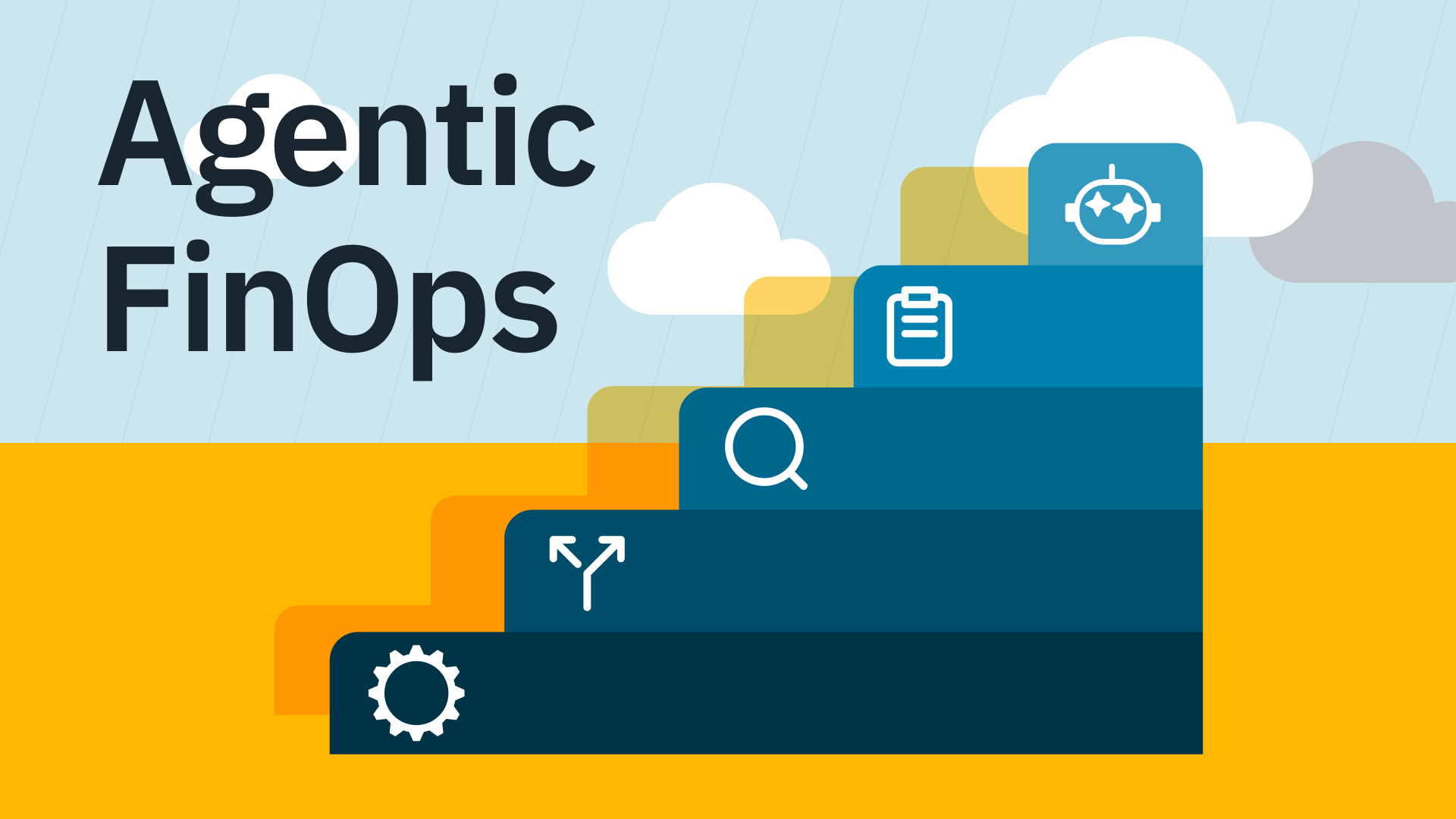
From there, there is a spectrum from deterministic automation to bounded autonomy. The levels differ by how much control the model has over the path, and how much authority it has been given.

Level 0
Not an Agent
Follows hardcoded rules written directly by a developer. Zero dynamic decision-making.
Example
A console button that auto-writes a cost query or returns a fixed recommendations list.
What it can change
Nothing (static)

Level 1
Picks Route
Dynamically chooses the optimal model or path based on system rules or prompt complexity.
Example
Routing easy queries to cheaper models and complex ones to premium models.
What it can change
Nothing (read-only)

Level 2
Picks Evidence
Investigates issues autonomously, searching live systems to diagnose structural changes.
Example
Tracing a budget spike to infrastructure modifications and specific code commits.
What it can change
Nothing (analysis only)

Level 3
Runs a Team
Orchestrates workflows by dividing complex tasks among multiple specialist AI components.
Example
Running automated audits where components flag anomalies, tag gaps, and draft summaries.
What it can change
Drafts only (no actions)

Level 4
Acts within Limits
Modifies production infrastructure autonomously within strict, predefined guardrails.
Example
Resizing a database: backing up, stopping, scaling, verifying, and rolling back on failure.
What it can change
Controlled production
Only the final level has authority to take or initiate changes within delegated limits. That does not mean the model itself has to execute every change. An agent can decide what should happen within approved guardrails, while deterministic automation performs the action. When discussing a “FinOps Agent”, the first question should therefore be: which level of the spectrum?
There is a separate choice about where the agent comes from, and it is independent of its level of agency. Cloud providers now ship agent capabilities inside their own consoles and cost tooling, which is quickest to start but usually scoped to one provider. Third-party cost platforms expose their own agent features over data you have already normalized. A team can also assemble its own using open connector standards, giving wider reach across billing, monitoring, ticketing and source control, at a higher build and security burden.
The decision depends on your FinOps Scopes, the complexity of your technology landscape, how many providers you run, whether your cost data is already consolidated, what context your organization will permit an agent to access, and separately, what authority it is prepared to delegate to it.
There are documented examples of agents operating with meaningful autonomy in FinOps, many of them shared at the recent FinOps X 2026 in San Diego during breakout talks.
But the more transferable pattern is not giving an AI model broad control of production infrastructure. It is finding areas where the agent can be given a narrow decision space and genuine authority without taking ownership away from the teams already responsible for the underlying systems.
That could mean updating an agreed forecast when defined conditions change, collecting evidence across cost and operational systems, applying an already approved policy change to deployment or runtime controls, or automatically targeting an optimization recommendation to the right engineer with the evidence needed to make the decision.
The last example is already visible in practice. A global financial services organization described an agentic rightsizing workflow that reasons over a recommendation, checks CPU and network history, and files the change ticket for Engineering rather than making the infrastructure change itself.
Taken together, the pattern is not that these teams have solved the reliability problem. They have reduced how much reliability has to carry. The decision space is narrow, policy defines the limits, evidence is gathered before action, and execution remains human-gated or deterministic where the risk requires it.
This also provides a practical path toward Acts within Limits. FinOps teams can first delegate authority over FinOps-owned workflows and controls, then extend that authority outside of their current remit only where the evidence, organizational trust and policy allow it.
Each step reduces the cost and consequence of being wrong.