Key Insight: The FinOps Framework has been updated to reflect the growing strategic role of FinOps in organizations working to maximize value from an expanding set of Technology Categories. The 2026 revisions introduce Executive Strategy Alignment as a new Capability, deepen the FinOps Scopes construct with richer guidance and additional Technology Category pages, explore the convergence of FinOps activities with other interconnected disciplines and update a number of Capabilities to be more inclusive of all Technology Categories.
Last year’s updates to the Framework marked a pivotal moment for the FinOps discipline with the formal recognition that FinOps Practitioners are managing technology value across a broader set of categories than public cloud alone, and the introduction of FinOps Scopes as a way for Finops practitioners to think about that reality.
The FinOps Framework 2026 builds on that foundation. The changes this year reflect something the community has been signaling clearly: that as FinOps has expanded, so too has the profile of the people FinOps needs to engage. Technology value has become a board-level conversation. The FinOps practice is increasingly expected to operate not just as an optimization function, but as a strategic partner to executive leadership that connects technology investment to business outcomes, supports multi-year planning, and enables informed tradeoffs across a complex and growing technology estate.
At the same time, Practitioners are working more deeply with more disciplines than ever. IT Service Management (ITSM), IT Asset Management (ITAM), IT Financial Management (ITFM), Sustainability, Security, and Enterprise Architecture teams all manage adjacent responsibilities across the technology estate in many organizations. The opportunity, and the challenge, is to ensure FinOps operates in coordination with those disciplines rather than in a silo.
The 2026 revisions address these realities.
2026 FinOps Framework Changes
In addition to the major themes above, Framework 2026 includes an updated FinOps definition that aligns with the recently updated FinOps Foundation mission, a set of targeted updates to existing Capabilities, and the introduction of a new Capability.
These updates reflect the ongoing work to ensure that FinOps Framework content aligns to executive priorities, is more inclusive of all Technology Categories, consistent with the concept of FinOps Scopes and the expansion of the discipline across more types of technology.
Updated FinOps Definition
With the updated FinOps Foundation Mission:
Advancing the People who manage the Value of Technology
The FinOps Definition has been aligned to this mission and updated:
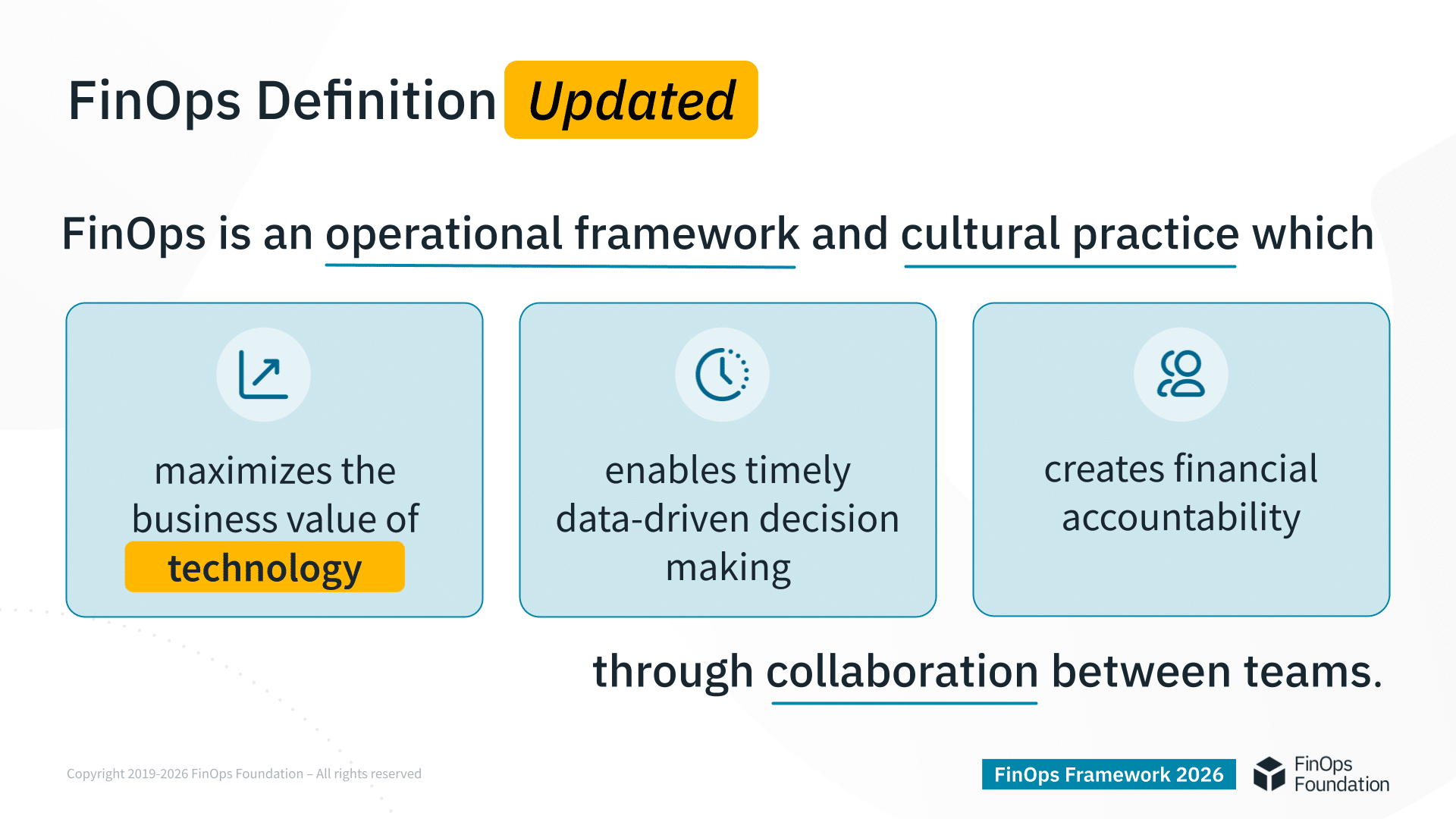
FinOps is an operational framework and cultural practice which maximizes the business value of technology, enables timely data-driven decision making, and creates financial accountability through collaboration between engineering, finance, and business teams.
FinOps Framework Capability Changes
New Capability
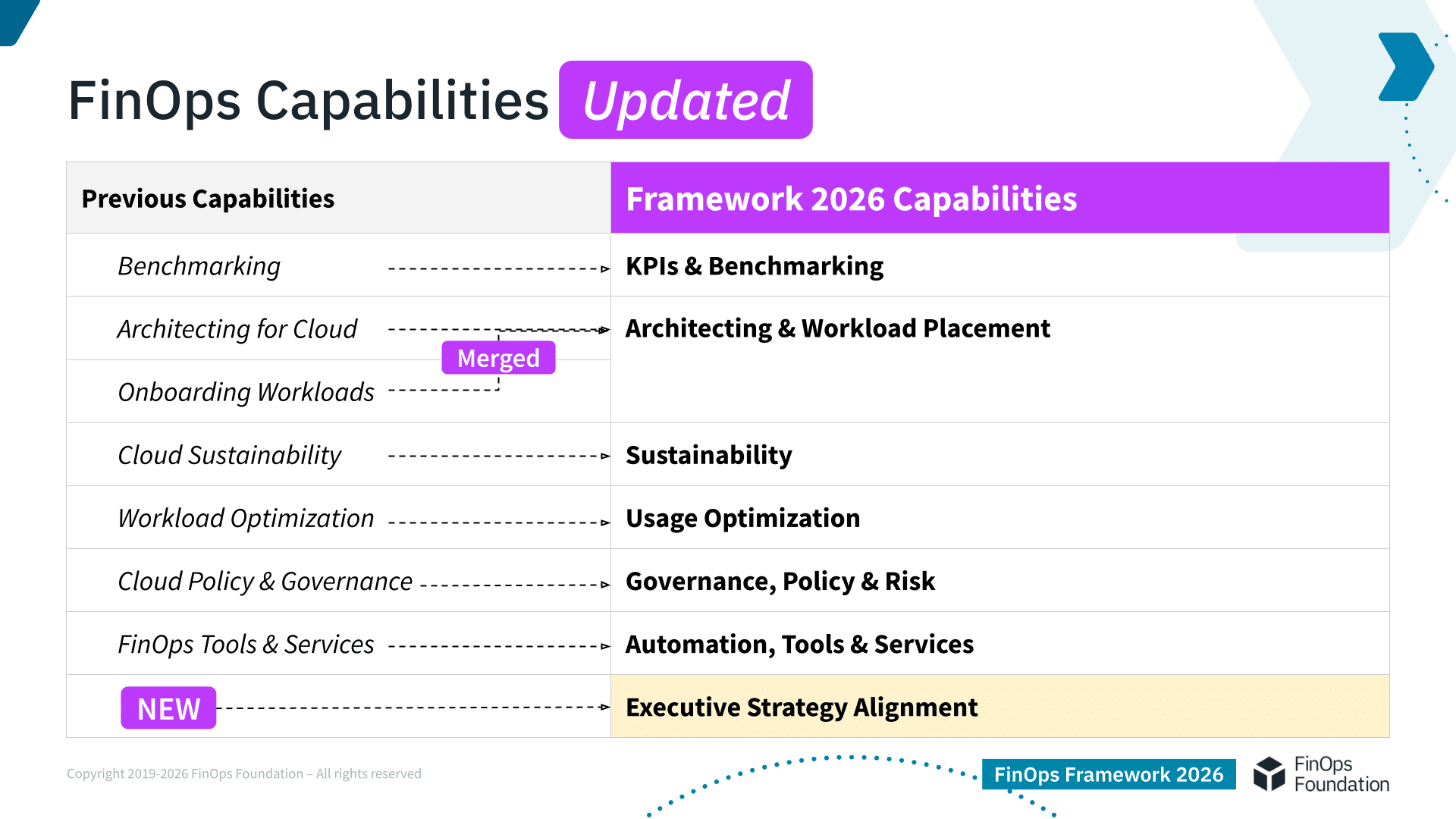
Executive Strategy Alignment: A new Capability in the Manage the FinOps Practice Domain. This Capability connects technology-related value to the organization’s business strategy and priorities, helping leaders compare options, make tradeoffs, and govern investment for value. It is organized around four areas: Executive Priority Alignment, Multi-Year Investment Strategy, Facilitate Product Prioritization Strategy, and Enable Strategic Decision Support.
Updated Capabilities
The following Capabilities have been updated for 2026, with deeper guidance on how to think about and apply FinOps concepts when defining FinOps Scopes:
Usage Optimization (formerly Workload Optimization): Renamed to reflect that optimization of technology resource usage applies across all Scopes. The Capability content has been updated throughout to replace cloud-specific references with technology-inclusive language.
Governance, Policy & Risk (formerly Policy & Governance): Updated to reflect that governance structures, policy frameworks, and risk considerations must account for the full range of technology categories and align across Intersecting Disciplines.
Automation, Tools & Services (formerly FinOps Tools & Services): Updated to address automation solutions, FinOps tools, and professional services across all technology categories, with a consistent three-category framing that provides FinOps Practitioners with direction for evaluating the right combination of solutions to drive outcomes based on business priorities.
KPI & Benchmarking (formerly Benchmarking): Updated to reflect that meaningful benchmarking requires the definition of KPI metrics aligned to specific technology categories and the business context defined by each FinOps Scope, rather than cloud-specific defaults.
Architecting & Workload Placement (formerly Architecting for Cloud): Updated to reflect that workload placement decisions increasingly must consider multiple technology categories, and that architectural decisions must account for value, performance, and business outcomes. The Capability now incorporates guidance on evaluating whether a technology category is appropriate for a given workload, and bringing those placement considerations earlier into the design and architecture process, before deployment commitments are made.
Sustainability (formerly Cloud Sustainability): Renamed and updated to reflect that sustainability considerations apply across technology categories, not only public cloud. The Capability now includes guidance on carbon allocation across on-premises, SaaS, colocation, and end-user computing environments, and introduces nuance around embodied versus operational carbon and the variability of regional emission factors.
FinOps Scopes: Richer Guidance, Broader Coverage
Introduced as a core element of the Framework in 2025, FinOps Scopes have continued to evolve based on community feedback and working group input. The 2026 updates reflect a more mature understanding of how Scopes work in practice, not just as a way to segment spending, but as the practical mechanism through which business strategy is translated into FinOps activities.
A More Complete Definition
The definition of a FinOps Scope has been refined to better reflect this role:
A FinOps Scope is a defined segment of spending across technology categories, aligned to business constructs—such as products, cost centers, or environment—that guide the application of FinOps to maximize technology value.
This refinement reinforces a distinction that matters: a FinOps Scope is not simply a view of spending by infrastructure type. It is a decision context—a view of specific initiatives or applications that may be in one technology category like cloud, or across many—that determines which Personas are engaged, which Capabilities are applied, and what measures of success are appropriate. The Technology Category is the “what.” The Scope is the “why.”
Scopes Are Driven by Business Questions
One of the most significant additions to the Scopes guidance is the emphasis on how Scopes are initiated. Scopes are not created because a topic is interesting or because a Practitioner wants to analyze a new area of spend. They are initiated in response to business expectations of specific outcomes, most often surfaced through questions from Leadership.
The updated guidance introduces a structured approach to drawing out business context before defining a Scope, encouraging Practitioners to go beyond the surface-level question to understand what outcome the business is actually trying to achieve. This reflects FinOps as a strategic partner in shaping decisions, not just a reporting function responding to data requests.
Example of a Scope
Defining a FinOps Scope for AI
In this example, this FinOps Scope for AI represents a business activity around AI innovation focusing on speed and quality.
| Business Strategies |
|
| Technology Strategies |
|
| Technology Categories |
|
| Personas Engaged |
|
| Key Capabilities |
|
| Cadence and Maturity |
|
Technology Categories
The Framework now includes Technology Categories, each providing guidance on how FinOps Capabilities, Personas, and measures of success apply within that category:
- FinOps for Public Cloud: covering IaaS and PaaS usage across cloud providers, with guidance on multi-cloud complexity, commitment management, and the pace of change that defines cloud FinOps practice
- FinOps for SaaS: focused on optimizing managed software spending to support organizational value creation
- FinOps for Data Center: improving visibility and decision-making for on-premises infrastructure investments
- FinOps for Data Cloud Platforms: covering consumption-based data and analytics spend across platforms like Snowflake, Databricks, and BigQuery
- FinOps for AI: addressing the cost complexity, spend unpredictability, and governance needs that come with AI investments spanning multiple technology categories
These pages reflect some of the multiple technologies the community of FinOps Practitioners are managing today. Each page follows a consistent structure—FinOps Considerations, Personas, Framework Domains and Capabilities, Measures of Success and KPIs, and FOCUS Alignment—helping Practitioners navigate the different procurement models, pricing constructs, cost visibility characteristics, and operational dynamics that shape how FinOps is applied to each technology category.
Scopes and Technology Categories work together to allow FinOps practitioners to more clearly define the context of their FinOps practice. While Technology Categories describe the broadening of the application of FinOps to more types of technology being reported in many organizations, Scopes describe the subset of spending and to which the FinOps practice needs to be applied based on particular business needs.
Scopes and the Lifecycle of a FinOps Practice
The updated Scopes guidance also introduces more detailed thinking about how Scopes evolve and interact over time. Scopes are situational and flex in duration and intensity to match the business objective being served. Practitioners are encouraged to recognize not only when a new Scope is needed, but when a Scope has served its purpose and activities can be scaled back or absorbed into existing practice.
The guidance also addresses Scope interactions and the reality that technology spending is often included in multiple Scopes simultaneously, carrying different business expectations in each. Managing these interactions intentionally is essential to ensuring that FinOps insights remain coherent and decision-relevant across the practice.
This updated guidance to scopes is simply improved documentation and does not represent a change to the original purpose of scopes as they were described last year at the FinOps X Day event in London.
Executive Strategy Alignment
Among the most significant additions to Framework 2026 is Executive Strategy Alignment, a new Capability in the Manage the FinOps Practice Domain.
This Capability formalizes something that mature FinOps practices have been developing organically for years: the connection between FinOps and executive decision-making. It reflects the reality that technology value has becomes a board-level conversation spanning Public Cloud, SaaS, Data Center, AI, and other categories, with pricing models that are increasingly complex and consumption-driven. FinOps does not operate solely as an optimization function. The result is an evolution from cost reporting and reactive optimization to proactive strategic partnership with leadership, shaping the decisions that determine how technology investment creates business value.
What Executive Strategy Alignment Does
The Capability is organized around four areas:
Executive Priority Alignment relates technology spend and usage to strategic initiatives and operational goals. For FinOps Practitioners, this begins with proactively engaging with and understanding the organization’s executive decision-making process, not seeking a seat at the table through mandate, but earning it by delivering trusted, high-quality data that becomes indispensable to the investment lifecycle. As that trust matures, FinOps moves from retrospective reporting to forward-looking decision support: strengthening forecasting, building unit economics, and enabling executives to act as sponsors of a shared ownership culture across Engineering and Product teams.
Multi-Year Investment Strategy uses FinOps cost and usage data, aligned with IT Financedata), to support enterprise budgeting, profit and loss (P&L) ownership, and long-term vendor commitment governance. It provides projections and lifecycle cost analysis so leaders can set guardrails and sequence modernization with full awareness of overlapping legacy, migration, and decommissioning costs. As organizations make significant bets on AI and other emerging technologies, the ability to identify efficiency opportunities that create financial headroom for new priorities becomes a critical FinOps contribution.
Facilitate Product Prioritization Strategy supports governance and optimization across technology assets, products, and projects so they collectively contribute to strategic goals. It makes cost, speed, and quality tradeoffs visible and comparable across competing initiatives, not just within individual projects, and brings FinOps review and advisory earlier into business design, project intake, and architecture decisions. The goal is to enable Leadership and Product Personas to compare options and understand expected value before major commitments are made.
Enable Strategic Decision Support establishes the operating model and ongoing support structures that connect executive intent to operational execution. This includes clarifying where the FinOps practice sits within the organization, which governance forums it supports, how it intersects with other disciplines, and how decision rights and spend guardrails are defined. It also addresses the need for FinOps to maintain continuity of measures and decision routines through organizational change including M&A, restructuring, and leadership transitions.
What This Capability Enables
Executive Strategy Alignment reflects a maturation in how FinOps is understood, positioned, and practiced. The FinOps Principle Business value drives technology decisions has always been central to the Framework. This Capability gives that Principle an operational structure at the executive level, defining how FinOps connects to the decisions that matter most, and how it earns and sustains the trust required to influence them.
For FinOps Practitioners, it provides a roadmap for expanding the practice’s strategic role, building credibility through high-quality insights, and progressively expanding to broader technology investments and governance forums. For executive leaders, it defines what a FinOps Enabled Executive looks like in practice, and what they should invest in to realize the full strategic value of FinOps.
FinOps and Intersecting Disciplines
As FinOps expands across a broader range of Technology Categories, FinOps does not operate in isolation. Organizations managing technology value across public cloud, data center, SaaS, AI, and other categories may also be operating within a wider ecosystem of IT management disciplines, each with its own frameworks, data, and responsibilities, and each contributing to the organization’s understanding of technology value.
When they exists in a larger organization, IT Asset Management (ITAM) and Software Asset Management (SAM) often focus on the the contractual value and lifecycle of software and hardware assets. IT Financial Management (ITFM) focuses on financial structures to account for how technology investment is reported and charged back to the general ledger. Sustainability teams manage the environmental impact of technology consumption. Security and Enterprise Architecture teams define standards and manage risk across the technology estate.
In organizations where they already exist these disciplines are not separate from FinOps. They are allied, adjacent, and increasingly converged with it. As technology investments grow and the complexity of managing them increases, the boundaries between these functions are becoming less meaningful than the connections between them. Organizations that treat these disciplines as siloed functions miss the opportunity to build a unified view; one that connects cost, usage, risk, compliance, environmental impact, and strategic outcomes in a way that is genuinely useful to decision-makers.
The FinOps Framework recognizes this convergence. The Intersecting Disciplines Capability provides a structure for FinOps teams to coordinate, cooperate, and collaborate with Allied Personas across these functions sharing data, aligning governance, and contributing to a common understanding of Total Cost of Ownership (TCO) and Return on Investment (ROI) across the organization’s technology estate.
This is not about FinOps absorbing or redefining other disciplines. It is about FinOps playing its part in a coordinated ecosystem, one where the insights each discipline generates are more valuable together than they are in isolation and where the organization’s leadership can make technology investment decisions with a complete and coherent picture of value.
Conclusion
The 2026 revisions to the FinOps Framework reflect where the discipline is heading: toward greater strategic influence, broader operational coverage, and deeper integration with the disciplines and decision-making structures that shape how organizations create value from technology investment.
Executive Strategy Alignment formalizes FinOps’ role as a strategic partner to leadership by shifting up from operational reporting to executive decision support. The deeper FinOps Scopes guidance gives Practitioners the tools to apply FinOps across an increasingly complex technology landscape. The convergence of FinOps with allied disciplines positions the practice within a coordinated ecosystem of technology management. And the refreshed Capability content ensures that the Framework serves Practitioners today that are managing value wherever technology resources are consumed.
As always, these updates are the result of continuous collaboration with the FinOps community of Practitioners, working group contributors, TAC members, and organizational members who bring the real-world experience that keeps the Framework grounded and relevant to the practice of FinOps today. Thank you to everyone who contributed.
Framework 2026 FAQs
Why was the Framework updated for 2026?
The 2026 revisions reflect the growing strategic role of FinOps in organizations creating value from technology across multiple technology categories. The updates introduce a new Capability called Executive Strategy Alignment, deepens the FinOps Scopes guidance, addresses the convergence of FinOps with allied disciplines, and updates a set of existing Capabilities to be inclusive of all technology categories, not only public cloud.
What is Executive Strategy Alignment, and why is it new?
Executive Strategy Alignment is a new Capability that formalizes the connection between FinOps and executive decision-making. It reflects the reality that as technology investment becomes more complex, FinOps must shift up, operating as a strategic partner to enable leadership, beyond being an optimization or reporting function. The Capability provides guidance for both FinOps Practitioners and executive leaders on how to build and sustain that partnership.
What does “FinOps Enabled Executive” mean?
A FinOps Enabled Executive is typically a senior leader at the C-1 level (VP, SVP, or EVP) who uses FinOps to support strategic outcomes across the executive suite. They position FinOps as a strategic advisory function, sponsoring shared ownership of cost and value decisions and ensuring FinOps insights are applied consistently across investment governance, multi-year planning, and technology tradeoffs.
What does “shift up” mean in the context of FinOps?
“Shift up” describes the evolution of FinOps from a reactive, operationally-focused practice toward a proactive strategic function connected to executive decision-making. Just as “shift left” describes embedding FinOps earlier in the delivery lifecycle in design, architecture, and procurement, “shift up” describes elevating FinOps where technology investment strategy is shaped.
Does this mean FinOps is moving away from optimization?
No. Optimization remains a core activity of FinOps practice. What the 2026 updates recognize is that optimization is most valuable when it is connected to business strategy. Especially, when efficiency gains are understood in terms of business outcomes, and when the decisions that drive optimization are made with full awareness of strategic priorities and tradeoffs. Executive Strategy Alignment strengthens that connection; it does not replace the operational work of FinOps.
What else is new in Framework 2026?
The Framework now includes a section dedicated to Technology Category pages like Public Cloud, SaaS, Data Center, Data Cloud Platforms, and AI. Each page provides structured guidance on how to apply the Framework within that category when defining FinOps Scopes. The guidance has also been updated with richer content on how Scopes are initiated in response to business questions, how they evolve over time, and how to manage interactions between Scopes that overlap.
Is Public Cloud still the primary Technology Category of FinOps?
Yes. Public cloud remains a primary Technology Category of FinOps, as the practice was born to address the cost management challenges that arose with the variable cost model of cloud. The Framework continues to reflect that, while also ensuring that Practitioners managing value across other technology categories have equally relevant guidance.
How does FinOps relate to disciplines like ITAM, ITFM, and Sustainability?
As the State of FinOps Survey data shows, these disciplines are increasingly convergent with FinOps. As technology investment grows, the boundaries between these functions become less meaningful than the connections between them. The FinOps Framework’s Intersecting Disciplines Capability provides a structure for FinOps teams to coordinate and collaborate with Allied Personas across these functions, contributing to a unified view of technology value that is more useful to decision-makers than any single discipline can provide alone.
Which Capabilities were updated in 2026?
The following Capabilities received targeted updates: Sustainability (formerly Cloud Sustainability), Usage Optimization (formerly Workload Optimization), Governance, Policy & Risk (formerly Policy & Governance), Automation, Tools & Services (formerly FinOps Tools & Services), KPI & Benchmarking (formerly Benchmarking), and Architecting & Workload Placement (formerly Architecting for Cloud). In addition, Executive Strategy Alignment was introduced as a new Capability in the Manage the FinOps Practice Domain.
Does the Framework define all possible technology categories?
No. The Framework’s Technology Category pages provide guidance for the most common categories the community is managing today, but they are not exhaustive. FinOps Practitioners define Scopes based on their organization’s business priorities and technology strategy, and are encouraged to apply the Framework to whatever technology categories are relevant.
How does this update affect FinOps certification and training?
Training and certification content will be updated to reflect the 2026 Framework changes. Check learn.finops.org for the latest information on how these updates are reflected in available programs.

Topics
-
FinOps Foundation Perspectives