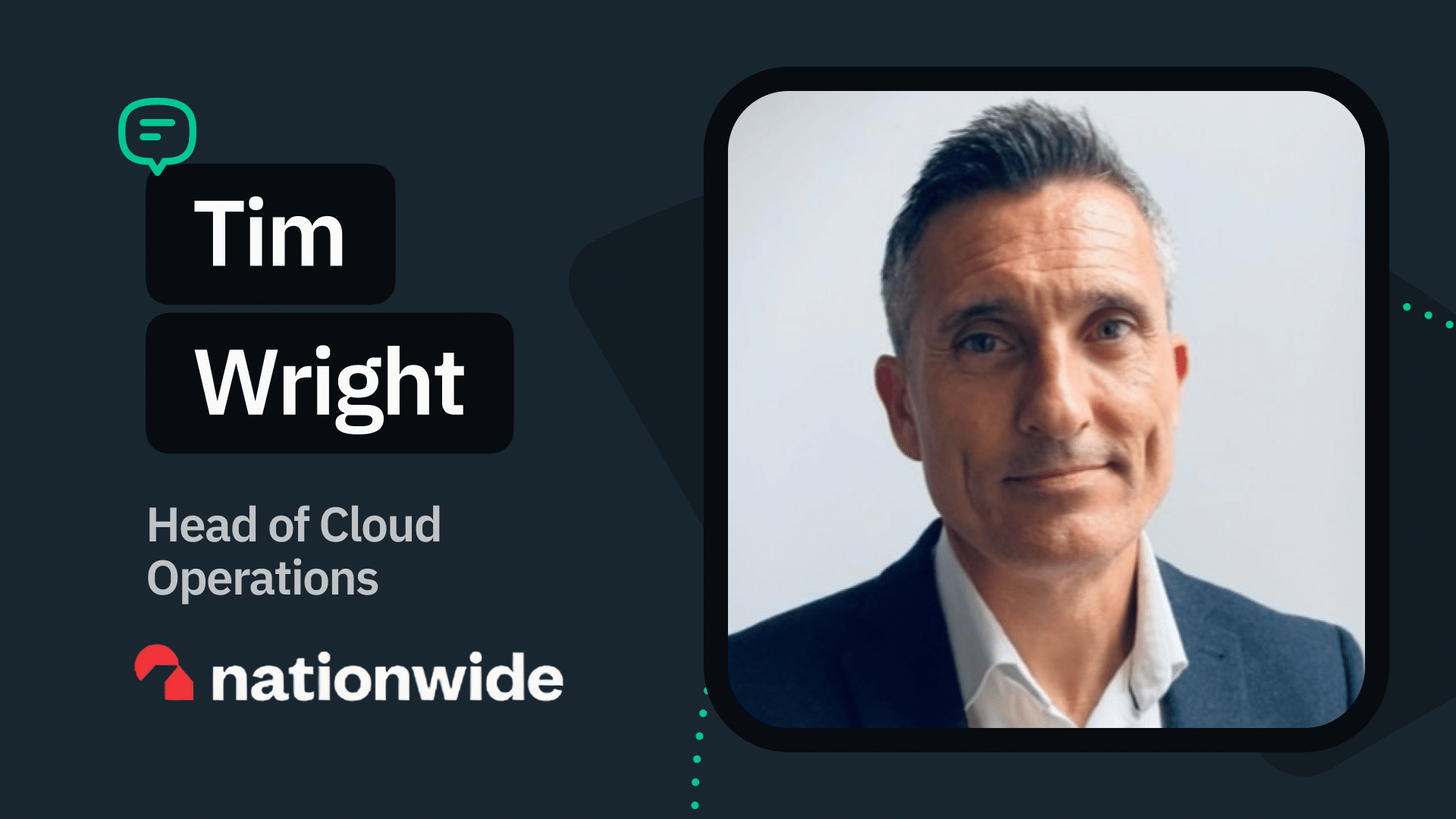
How a Head of Cloud Operations built a unified technology cost function spanning cloud, on-premise, software assets, and now evolving for AI.
Key Insight: Tim Wright, Head of Cloud Operations & IT Cost Management at Nationwide Building Society, has spent seven years building one of the most deliberately integrated FinOps practices in UK financial services. His story, from a small cloud team to a unified function covering FinOps, ITFM/TBM, and Software Asset Management, now expanding to AI, is a case study in what it takes to make cost accountability stick inside a financial services organization.
Tim Wright is Head of Cloud Operations and IT Cost Management at Nationwide Building Society, with accountability for Cloud Operations, Chaos Engineering, FinOps, IT Financial Management (cloud and on‑premise), and Software Asset Management. He is part of the senior leadership team reporting into Paul Walsh, Group Director of IT Infrastructure & Service Delivery, who reports directly to the Chief Operating Officer.
Seven Years, One Direction
When Tim Wright was asked to form Nationwide’s Cloud Operations team seven years ago, the mandate was narrow and the team was small. “At the time, it was literally me and an engineer that had a passion for learning and development,” he recalls.
Over the next seven years, that team grew into a four-pillar Cloud Operations function covering operational engineering, chaos engineering, platform management, and FinOps. It absorbed ITFM and Software Asset Management into a unified practice. Most recently, its scope expanded again to include CICD Operations and following the Virgin Money acquisition by Nationwide, the Virgin Money Cloud Operations Team.
Tim’s title today, Head of Cloud Operations & IT Cost Management, is deliberately worded. “It’s not Head of Cloud Operations and Cloud Cost Management. Because I don’t want people to assume it’s just cloud cost management. It’s broader now.”
One Function, Three Domains
One of Tim’s most deliberate strategic choices was unifying cloud FinOps, ITFM, and Software Asset Management under a single function, branded simply as “FinOps.”
The practice began with Andy Foley focused on cloud FinOps. It expanded to encompass ITFM under Sasha Dunford, and as of last year, Software Asset Management as well, also under Sasha’s leadership.
The rebrand followed the language the business was already using. “When my boss Paul Walsh spoke about FinOps to our COO, he labelled everything as FinOps whether he was speaking about cloud or on-premise,” Tim explains. “We’ve rebranded the team to just be FinOps now, because that’s what external insight is showing as well. FinOps is expanding to include these functions.”
Building Visibility and Shared Accountability
One of the structural decisions that has shaped how FinOps operates at Nationwide is the move to a consolidated showback model for cloud consumption (both public and private). All public cloud spend now rolls up into a single, visible budget owned by Tim, with transparent breakdowns by CIO team and applications.
The model has been a genuine enabler for the organization. It gives every CIO team a clear, shared view of their consumption against forecast, and it gives the executive team a single, consistent picture of where cloud investment is flowing across the enterprise. Tim describes the shift as positive cultural change his team in partnership with Finance has driven. “Teams can see exactly what their contribution is, what they committed to, and whether they’re tracking to it. That clarity has been really healthy.”
The COO has been a critical partner in making the model work bringing a consistently data-led approach to investment and BAU decisions. “Our COO is an intensely data-driven decision maker which is why FinOps resonates because when he asks for the facts, we can respond quickly with the numbers, the drivers, and the options.”
The pattern is one the Foundation has seen play out across mature FinOps organizations. At the Foundation’s April 2026 AI Value Executive Summit, leaders discussed the same move toward real-time showback as a way to create centralized accountability while giving individual teams the granular visibility they need to make better decisions. For Tim, that executive-level appetite for data has been the consistent foundation underneath everything else his team has been able to build.
Software Asset Management: Quick Wins, Broader Strategy
The expansion into Software Asset Management has moved quickly from organizational design to practical results. Using tooling that integrates directly with end-user devices, the team has started running targeted optimization campaigns.
One recent campaign surfaced laptops with a specific application installed and asked the end user a simple question: do you still need this? By the end of a single day, more than a hundred users had confirmed they no longer needed the software. “That was almost like a little proof-of-concept campaign,” Tim says. “We’re really going to progress forward with that now with Sasha and the team identifying what other campaigns we should run, based on intelligence from our end user experience monitoring platforms, but keeping a human in the decision-making loop.”
The SAM strategy is also broadening in scope. Previously focused on the top software providers by spend, the team is now extending coverage to the long tail of smaller agreements that had been outside the optimization perimeter. SaaS is coming into scope, as are licencing considerations embedded at design stage. And his team are tightening internal guidance about how to handle inbound contact from software providers, a discipline that matters acutely in regulated industries where an ill-considered response can trigger a compliance audit.
The Shift Left Problem
The most immediate structural challenge Tim is working through has a name he borrows directly from the FinOps community: shifting left.
Nationwide’s delivery pace is ambitious but considered, and the message reaching engineering and CIO teams centers on speed. The separate conversations about cost efficiency happen at a different altitude, and the two messages have not always reconciled before they reach the teams doing the work.
“I want to raise visibility,” Tim says, “and have a conversation that says: whilst we recognize the need for pace, there’s also a need for cost discipline, and it needs to be shifted left so that it’s being designed to be cost-optimized, it’s being built cost-optimized, and crucially the cost data gets in the line of sight of engineers before they deploy so they can make more informed decisions.”
His intent is to tackle shift left from both directions: a leadership track that aligns incentives, expectations, and governance around cost discipline, and an engineering track that embeds cost signals and guardrails into day-to-day delivery so teams don’t have to “play catch-up” once services are already running.
The Foundation’s AI Value Executive Summit reinforced this principle from a different direction. Leaders there described baking FinOps into code at the design stage rather than chasing it after the fact, using technical enablers like Terraform to embed firm-wide constraints from the start. As one executive put it, because spend is non-linear, FinOps teams cannot chase down developers after the fact.
Getting Ahead of AI Spend
Material AI spend is now appearing in Nationwide’s financial year forecasts for the first time, a signal that the AI strategy is moving from document to deployment. Tim and Andy identified this early.
“Having identified early signals in the forecasts, the FinOps team recognised the need to prepare for AI cost management. ‘As a FinOps team, once we saw AI spend emerging in our forecasts, Andy and I were clear that we needed to get ahead of it,’ Tim explains. We have invested in AI FinOps training and certification for the team through the Foundation, intentionally building capability before the business came asking.
That proactivity paid off quickly. Inbound arrived from executives running Nationwide’s BAU cost forum asking for insight into FinOps for AI. The team had been preparing for exactly that conversation.
Tim and Andy’s instinct to get ahead of AI cost before the business asks is shared across the executive community. Leaders at the Foundation’s AI Value Summit described AI spend growing at non-linear rates, with warnings that unchecked growth could reshape technology budgets within a few years. The consensus was that translating token utilization back to currency and to business-area consumption in real time is essential, because token costs vary wildly across providers and raw token comparisons are, as one infrastructure leader put it, “a red herring.” Tim is positioning his team to have that capability in place before the question arrives.
From Cost to Value
Tim is direct about the gap between where his function is and where he wants it to be.
“It’s great we’re taking costs out, but I’d much rather the team had more time thinking forward and strategizing. We hadn’t had our chance to think about how we’re going to wrap FinOps around AI until now because we’ve been doing this other stuff.”
The tension he describes appears consistently among FinOps leaders at this stage of maturity. Success at demonstrating savings creates demand for more of the same work, which crowds out the capacity to build for the next challenge. Shifting the balance from reactive optimization to proactive strategic advisory is the cultural and organizational problem underneath the technical ones.
Tim’s longer-term ambition is to change the terms of the conversation entirely. “I want to change the narrative to be more about the value we get from technology not just the cost of it.”
What Nationwide’s Story Tells the Field
Tim Wright’s journey is not finished. The integration with Virgin Money is still ongoing. The AI cost management capability has to be built. The shift left conversation is still being had. The SAM expansion into SaaS is in its early stages.
What the story does offer is a detailed account of what building integrated FinOps at enterprise scale actually looks like: incremental, data-driven, and relentlessly iterative. Seven years from a small team to a unified practice covering cloud, on-premise, and software assets, and still expanding.
The Foundation’s State of FinOps data shows that organizations with FinOps practices at this level of integration consistently report greater influence over technology investment decisions and stronger executive alignment than those managing cloud in isolation. The challenges Tim is describing are the field’s challenges: shifting left before the bill arrives, expanding scope without losing depth, and managing AI spend before the forecasts get away from you. These are not Nationwide’s problems alone. They are where enterprise FinOps is right now.
About Nationwide Building Society
Nationwide Building Society is the world’s largest building society, serving more than 16 million members and is the UK’s second‑largest provider of mortgages and retail deposits. Nationwide is driven by a clear purpose: Banking – but fairer, more rewarding, and for the good of society. This member‑focused approach has been recognised with multiple accolades, including Which? Banking Brand of the Year 2025 and UK’s best bank in Forbes World’s Best Bank 2026.
Join the FinOps Newsletter
Keep up to date with the latest news from the FinOps Foundation, our partners and practitioners.